
Ever wonder how tiny pellets fuel global agriculture? Let me break it down. The ki̇myasal gübre üreti̇m süreci̇ transforms raw materials like air, rocks, and gas into precision nutrients that boost crop yields worldwide.
With 50% of today’s food supply relying on synthetic fertilizers, mastering this process isn’t just chemistry—it’s survival. By 2026, production efficiency will make or break farms facing climate extremes.
Bu kılavuzda, bir profesyonel olarak gübre üretim hattı manufacturer, I will share the whole chemical fertilizer production process, and cover Haber-Bosch efficiency, cadmium risks, precision coating tech, and 2026 innovations like carbon-capture fertilizers.
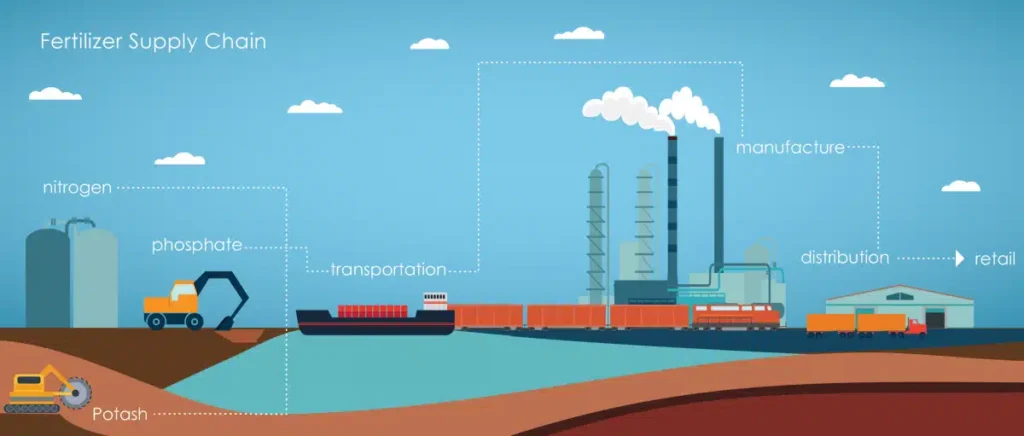
Why Chemical Fertilizer Manufacturing Matters (More Than You Think)
Hungry planet? You bet. By 2026, we’ll need to feed 8 billion people on less arable land. Chemical fertilizers bridge that gap. But poor quality control or outdated processes? That wastes resources and pollutes waterways.
Önemli istatistikler:
- Nitrogen fertilizers alone support 48% of global food systems (FAO 2026 projection)
- Production efficiency improved 22% since 2020 through automation
- Every 1% gain in nutrient precision saves 4.3B gallons of water annually
Profesyonel İpucu: Want sustainable agriculture? Start with precision manufacturing.
Raw Materials: The Building Blocks of Plant Food
All fertilizers start with three rockstars: Nitrogen (N), Phosphorus (P), and Potassium (K). But acquiring them? That’s where the magic begins.
Nitrogen Extraction: Fixing the Unfixable
Nitrogen’s tricky—it’s 78% of our air, yet plants can’t use it directly. Solution? The Haber-Bosch süreci. I’ll walk you through it:
1. Natural gas + air: Methane (CH₄) meets atmospheric nitrogen (N₂)
2. High-stakes reaction: 500°C temps + 200 atm pressure
3. Amonyak (NH₃): The gateway to all N-fertilizers
Fun fact: This single reaction consumes 3-5% of global natural gas. That’s why 2026 tech focuses on renewable-powered reactors.
Phosphate Rock: Digging Deep
Ever held a fertilizer granule? Its P likely came from Moroccan mines or Florida deposits. Production steps:
- Mining: Strip away clay/sand to reach fluorapatite rock
- Beneficiation: Crush, wash, and concentrate to 32% P₂O₅
- Chemical stripping: Remove cadmium and heavy metals (critical for EU compliance)
Potash: The Potassium Gold
Mined 3,000 feet underground in Saskatchewan or evaporated from Dead Sea brine. Processing is simpler:
- Dissolve ore
- Filter impurities
- Recrystallize into pure KCl (potassium chloride)
Profesyonel İpucu: Russia/Belarus produced 40% of global potash pre-2023. Post-sanctions? New deposits in Brazil and Canada are booming.
Chemical Fertilizer Production Process
Step 1: Ammonia Synthesis (The Nitrogen Nexus)
All nitrogen fertilizers originate here. Modern plants recycle heat to cut energy use 18% vs. 1990s models.
- Reactor input: 3H₂ + N₂ → 2NH₃
- Catalyst formula: Magnetite (Fe₃O₄) with potassium promoters
- Output pressure management: Turbo-expanders recover 80% energy
Production reality check: Without green hydrogen tech, this step stays emissions-heavy. Pilot plants in Norway aim to fix this by 2026.
Step 2: Phosphoric Acid Concentration
Raw phosphate rock alone won’t cut it. Acidulation unlocks soluble P:
Wet process method (Most common):
Ca₅(PO₄)₃F + 5H₂SO₄ + 10H₂O → 3H₃PO₄ + 5CaSO₄·2H₂O + HF
HF gas is captured for aluminum refining
Profesyonel İpucu: “Purple acid” (high-purity H₃PO₄) sells at 20% premium for food-grade fertilizers.
Step 3: NPK Formulation – Where Ratios Rule
Farmers don’t buy elements—they buy solutions. Blending determines efficacy:
| Gübre Türü | NPK Formula | Crop Application |
|---|---|---|
| Wheat Booster | 27-13-0 | Pre-tillering |
| Fruit Catalyst | 12-12-24 | Flowering stage |
| Turf Builder | 20-5-10 | Spring green-up |
Automated batching systems now achieve 99.8% formula accuracy—no more guesswork.
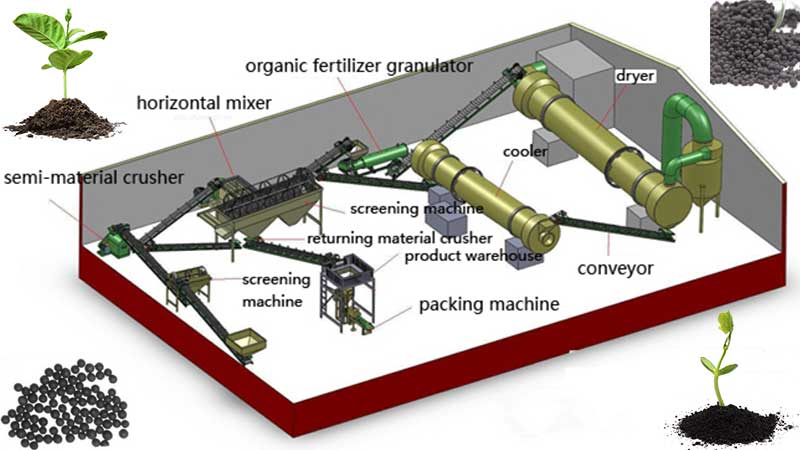
Granulation: Crafting the Perfect Pellet
Why granules? Dust-free application and controlled nutrient release. Modern lines use steam granulation to cut emissions 45%.
Critical Stages:
1. Pre-mixing: Powders + liquids homogenized
2. Granulator drum: Rotating action builds layers like an onion
3. Kurutma: 130°C fluidized beds remove moisture without cracking
4. Soğutma: Counter-current air stabilizes structure
5. Tarama: 2-4mm granules kept; oversize recycled
6. Kaplama: Anti-caking agents (e.g., vegetable oils) applied
Profesyonel İpucu: Look for opaque granules—translucency signals moisture leaks during drying.
2026 Innovations: Smarter, Greener Production
Electrochemical Ammonia (Game Changer?)
MIT’s prototype reactors ditch Haber-Bosch with:
- Lithium-mediated nitrogen reduction
- Solar-powered electrolysis
- Room temp/pressure operation
Current yield: 2% vs. 50-80% for industrial HB. Promising? Yes. Viable by 2026? Unlikely at scale.
Carbon Capture Fertilizers
Yara’s Porsgrunn plant now injects CO₂ into fertilizer coatings:
- Stores 800,000 tons CO₂/year
- Adds slow-release carbon for soil health
- Qualifies for EU carbon credits
Biostimulant Blends
2026’s hottest trend? Fertilizers packed with:
- Mycorrhizal fungi
- Deniz yosunu özleri
- Hümik asitler
Field trials show 9% better N uptake in corn.
Why Production Quality = Farm Success
Bad fertilizer isn’t just ineffective—it’s dangerous. Remember the 2023 Kenya incident? 200 farms lost to cadmium contamination. Quality control is non-negotiable.
Plant QC checklist:
- XRF analyzers vet incoming ores
- Near-infrared sensors track granule integrity
- ICP mass spec tests final products at 100g intervals
- Blockchain batch IDs link factory to field
The Environmental Tightrope: Balancing Yield and Impact
Fertilizer runoff fuels algae blooms. But 2026 solutions are emerging:
Precision coating tech
- Polymer shields reduce leaching by 67%
- pH-triggered release matches plant uptake
Digestate integration
Biogas plants now pipe ammonia from manure into fertilizer lines. Closing the nutrient loop? Yes, please.
Water recovery systems
Modern scrubbers condense 5M gallons/year from exhaust steam for reuse.
Sonuç olarak? Dirty production helps no one. Clean tech pays for itself in 3-5 years.
Final Thoughts: The Future of Fertilizer
By 2026, chemical fertilizer production won’t just feed crops—it’ll heal soils and slash emissions. From recycled-nutrient formulas to solar-powered Haber-Bosch, innovation is accelerating.
Bu ki̇myasal gübre üreti̇m süreci̇ remains agriculture’s backbone… but smarter engineering will make it its conscience too. Sound like sci-fi? It’s already happening in Rotterdam and Rajasthan pilot mills.
Want proof? Visit a modern plant. You’ll smell nothing. Hear whispers. See stainless steel gleaming. This isn’t your grandpa’s fertilizer. It’s precision agriscience—granule by granule.


 Turkish
  English
  Spanish
  French
  Russian
  German
  Italian