
Want to turn kitchen scraps and farm waste into black gold?
Tired of synthetic fertilizers leaching into your soil?
Here’s the deal: small scale organic fertilizer production isn’t just eco-friendly—it’s a dirt-cheap business opportunity.
As a professional organic fertilizer production line manufacturer, I’ve helped dozens of farmers and entrepreneurs launch micro-operations (some earning $30k/year part-time). Let me break down how you can tap into this $14.6 billion organic fertilizer market—no industrial experience needed.

Why Your Backyard Could Be a Organic Fertilizer Factory
Sound crazy? It’s not.
- 70% less startup costs than conventional farms (under $15k for basic setups)
- Zero-waste appeal: Repurposes manure/food waste (40% of landfills)
- Exploding demand: Organic food sales hit $72 billion in 2025—farmers need your product
But here’s the thing: Most beginners overcomplicate it.
The 4-Step Small-Scale Organic Fertilizer Production Blueprint (From Waste to Profit)
Step 1: Sourcing Raw Materials (It’s Literally Garbage)
Pro Tip: Mix nitrogen-rich + carbon-rich ingredients:
| Nitrogen Sources (Greens) | Carbon Sources (Browns) |
|---|---|
| Cow/pig/chicken manure | Straw or hay |
| Food scraps | Dried leaves |
| Coffee grounds | Wood chips |
I personally recommend partnering with local cafes for free coffee grounds (they’ll thank you).
Step 2: Composting—The Alchemy Phase
The bottleneck? Oxygen. Without it, you get sludge.
- Moisture control: Aim for 50-60% (squeeze test: damp sponge)
- Aeration hacks:
- Turn piles every 3 days with a mini compost turner ($2k–$8k)
- Use PVC pipes with holes as DIY aerators
- Temperature matters: 130°F–150°F kills pathogens (get a $20 compost thermometer)
Case Study: Sarah in Vermont processes 5 tons/month using a self-propelled turner. Her secret? Adding crushed eggshells for calcium—cuts composting time to 18 days.
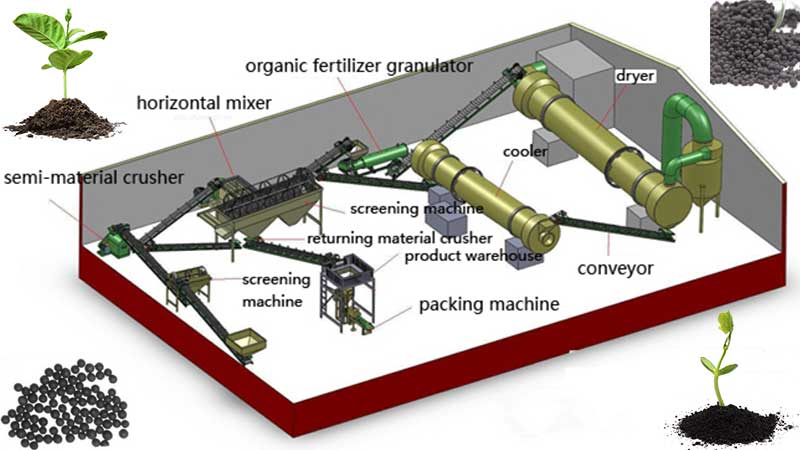
Step 3: Grinding & Granulating (The “Value-Add” Play)
Powdered compost sells for $50/ton. Granules? $300/ton.
- Essential gear:
- Semi-wet material crusher ($5k–$15k): Pulverizes clumps
- Disc granulator ($8k–$20k): Shapes compost into uniform pellets
- Natural binders: Molasses or clay (avoids synthetic chemicals)
Pro Tip: Skip granulation if selling to boutique farms—they often prefer raw compost.
Step 4: Packaging & Branding—The Profit Multiplier
Data point: Bagged organic fertilizer outsells bulk by 3X.
- Low-cost packaging:
- 5lb resealable bags for home gardeners ($0.15/unit)
- 50lb woven sacks for farms
- Label magic: Highlight NPK ratios (ideal: 4-3-2) and microbial content
My #1 hack: Sell “custom blends” (e.g., “Tomato Boost” with extra phosphorus).
More Tips for Small Scale Organic Fertilizer Production
Must-Have Equipment Under $25k
| Equipment | Function | Price Range | Capacity |
|---|---|---|---|
| Compost Turner | Aerates piles | $2k–$8k | 1–5 tons/day |
| Moisture Tester | Checks water content | $20 | — |
| Crusher | Pulverizes compost | $5k–$15k | 1–8 m³/h |
| Granulator | Forms pellets | $8k–$20k | 1–10 tons/day |
| Bagging Scale | Weights & packs | $3k–$10k | 10–30 bags/h |
Real talk: Start with just a turner and bags. Rent a grinder monthly until sales justify the cost.
Site Setup: Dirt-Simple Logistics
Location rules:
- ☑️ Near manure sources (dairies, poultry farms)
- ☑️ Away from residential zones (odor complaints = shutdowns)
- ☑️ Covered area for rain protection (a $500 tarp structure works)
Odor control: Bury new piles under finished compost—it’s a natural biofilter.
Profit Potential: Crunching the Numbers
- Production cost: $80/ton (labor, inputs, power)
- Selling price: $150–$500/ton
- Break-even point: 6–8 months at 5 tons/month
Success story: Mike in Ohio nets $42k/year running his operation 10 hours/week. His edge? Direct deals with organic vineyards paying premium prices.
3 Landmines to Avoid (Save $10k+)
- Skipping lab tests: Unbalanced NPK = dead plants = lawsuits. ($50 soil tests prevent this.)
- Ignoring local regs: Some states require licensing for “soil amendments.”
- Over-investing early: Don’t buy a $15k granulator before securing buyers.
Marketing: How to Sell Every Gram
Farmers market tactic: Give free samples with planting instructions.
Online play: Run Google Ads targeting “organic compost near me”—captures ready-to-buy customers.
Pro Tip:
“During granulation, maintain 30% moisture for optimal pellet stability. Use a horizontal mixer for even nutrient distribution—consistency is what commercial buyers monitor.”
The Future Is Circular (Your 2025 Roadmap)
Municipalities are paying producers to handle food waste. Partner with them for zero-cost raw materials + tipping fees.
Bottom line?
Small scale organic fertilizer production turns waste streams into revenue streams. Start with 5 tons/month. Scale with demand. And watch your garbage become someone else’s gold.
“The best fertilizer? The farmer’s footsteps.”
But in 2025? It’s your compost turner’s hum.
Ready to dig in?


 English
  Spanish
  French
  Russian
  German
  Italian