
What is an Organic Fertilizer Machine?
What is an organic fertilizer machine exactly? It’s specialized equipment that transforms organic waste like animal manure, crop residues, and food waste into nutrient-rich fertilizer through controlled processing. These machines have revolutionized sustainable farming by turning agricultural waste into valuable soil amendments.
Here’s the deal:
Farmers worldwide are ditching chemical fertilizers for organic alternatives. And organic fertilizer machines make this shift possible on a massive scale.
In fact, the organic fertilizer market is exploding right now. We’re talking about a $15.8 billion industry by 2027.
But here’s what’s really interesting:
These machines don’t just create fertilizer. They solve major environmental problems while generating serious profit for farm operations.
As a professional organic fertilizer production line manufacturer, let me show you exactly how these systems work and why they’re becoming essential for modern agriculture.

How Organic Fertilizer Machines Actually Work
An organic fertilizer machine isn’t just one piece of equipment.
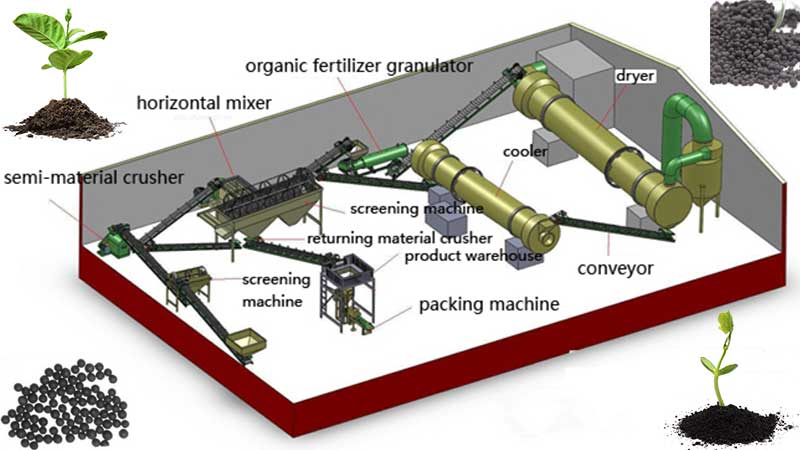
It’s actually a complete production line with multiple specialized machines working together.
Think of it like an assembly line for turning waste into gold (well, brown gold).
The Complete Production Process
Here’s how raw manure becomes premium fertilizer:
Step 1: Pre-Fermentation
First up, you need to prepare your raw materials.
This is where compost turners come in. These bad boys aerate massive piles of organic waste, creating perfect conditions for beneficial bacteria to thrive.
The result? Internal temperatures hit 60-70°C, which kills pathogens and weed seeds.
(Pretty important if you don’t want to spread disease across your fields.)
Step 2: Crushing and Mixing
After 15-30 days of composting, you’ve got stable organic matter.
But it’s still too chunky.
Semi-wet crushers break everything down into fine particles. Then horizontal mixers blend in any additives to create a uniform mixture.
This step is CRUCIAL for consistent nutrient distribution.
Step 3: Granulation
Now for the magic:
The mixed material gets formed into uniform pellets using granulation equipment. Different types include:
- Disc granulators (great for small operations)
- Rotary drum granulators (perfect for large-scale production)
- New type organic granulators (eco-friendly option)
Why pellets? They’re easier to store, transport, and apply to fields. Plus, they release nutrients slowly over time.
Step 4: Drying and Cooling
Fresh pellets contain 30-40% moisture.
Too wet for storage.
Rotary dryers reduce this to below 15%, while cooling machines bring temperatures back to normal. This prevents caking and preserves pellet structure.
Step 5: Screening and Packaging
Finally, screening machines sort pellets by size.
Only the perfect ones make it through.
Automatic packaging machines then bag everything up for distribution. Usually in 25kg or 50kg bags.
Types of Organic Fertilizer Equipment
Let’s break down the key machines in detail:
Compost Turners: The Workhorses
These machines are the backbone of organic fertilizer production.
Self-Propelled Turners
- Process 500-2,000 m³ per hour
- GPS-guided for precision
- Perfect for large-scale operations
Groove-Type Turners
- Handle 300-1,500 m³ per hour
- Fixed-path operation
- Ideal for municipal composting
Crawler Turners
- Process 200-800 m³ per hour
- Flexible positioning
- Great for medium farms
The best part? Modern turners can reduce composting time from months to just 15-20 days.
Granulation Equipment: Creating the Perfect Pellet
Different granulators serve different purposes:
Stirring Tooth Granulators excel at processing high-moisture materials. They achieve 85-95% granulation rates while keeping beneficial microorganisms alive.
Disc Granulators use centrifugal force to create spherical pellets. You can adjust disc angle and moisture to control pellet size precisely.
Drum Granulators handle massive volumes efficiently. The tumbling action gradually builds up pellet size for uniform, high-density results.
Drying Systems: Moisture Control Masters
Nobody wants soggy fertilizer.
Rotary dryers are the go-to solution. They use heated air to reduce moisture from 25-30% down to 10-15%.
Advanced models even recover heat, improving energy efficiency by up to 40%.
(That’s huge for keeping operating costs down.)
The Real Benefits of Organic Fertilizer Machines
Here’s why farms are investing millions in this equipment:
Environmental Impact
Check this out:
A facility processing 50,000 tons annually can reduce methane emissions by 2,800 tons of CO₂ equivalent.
That’s like taking 600 cars off the road.
But it gets better:
- Eliminates 99.9% of pathogenic bacteria
- Prevents groundwater contamination
- Increases soil carbon sequestration
- Supports biodiversity
Economic Advantages
The numbers speak for themselves:
Processing costs: $15-30 per ton
Selling price: $200-400 per ton
Do the math. That’s some serious profit margin.
Revenue streams include:
- Direct fertilizer sales
- Custom processing services
- Premium organic certification
- Reduced waste disposal costs
- Carbon credit income (in some markets)
Most operations see full ROI in 3-5 years. After that? Pure profit with 30-50% margins.
Agricultural Benefits
Pelletized organic fertilizer crushes raw manure in performance:
- 15-25% better nutrient uptake
- Controlled release reduces leaching
- Consistent 2-4% nitrogen content
- Essential micronutrients included
- Improved soil structure
Real-World Success Story
Let me share a killer example:
A Wisconsin dairy farm with 2,000 cows invested $280,000 in a complete processing line.
Their setup:
- Self-propelled compost turner
- Twin-shaft mixer
- Disc granulator
- Natural gas dryer with heat recovery
- Vibrating screen
- Semi-automatic bagging
The results?
They process 12,000 tons of manure yearly, producing 8,500 tons of finished fertilizer.
Operating costs: $22/ton
Revenue: $180/ton
Annual profit: $1.3 million
Payback period? Just 3.2 years.
Now they’re processing manure from three neighboring farms too.
Choosing the Right Equipment
Different operations need different setups:
Small-Scale (1,000-5,000 tons/year)
- Investment: $80,000-150,000
- Basic composting, crushing, granulation
- Some manual operation required
Medium-Scale (5,000-20,000 tons/year)
- Investment: $200,000-500,000
- Automated systems with integrated controls
- Reduced labor requirements
Large-Scale (20,000+ tons/year)
- Investment: $1 million+
- Fully automated production
- Lowest per-ton processing costs
Key Considerations for Success
Want to nail your organic fertilizer operation? Pay attention to these factors:
Raw Material Supply
You need consistent organic waste streams. Partner with local farms, food processors, or municipalities.
Market Demand
Research local fertilizer prices and farmer needs. Organic certification can command premium prices.
Regulatory Compliance
Different regions have different rules:
- USDA Organic standards
- EU fertilizer regulations
- State registration requirements
- Heavy metal limits
- Pathogen reduction protocols
Quality Control
Monitor these specifications:
- Maximum moisture content (≤30%)
- Minimum organic matter (≥30%)
- Consistent particle size
- Nutrient content verification
Common Questions About Organic Fertilizer Machines
What raw materials work best?
Pretty much any organic waste works:
- Livestock manure (dairy, poultry, swine)
- Crop residues (corn stalks, wheat straw)
- Food processing waste
- Municipal biosolids
The key? Getting the right carbon-to-nitrogen ratio (25-30:1).
How long does production take?
Composting: 15-30 days
Mechanical processing: 4-8 hours
Total time to finished product: 24-48 hours once running
What about maintenance?
Regular maintenance includes:
- Daily cleaning
- Weekly lubrication
- Monthly inspections
- Quarterly wear part replacement
Annual overhauls typically cost 3-5% of equipment value.
Power requirements?
Small systems: 50-100 kW
Large industrial lines: 500+ kW
Energy costs usually represent 15-25% of operating expenses.
The Future of Organic Fertilizer Production
Here’s what’s coming:
Advanced automation is reducing labor costs even further. AI-powered systems optimize composting conditions in real-time.
New granulation technology handles higher moisture content, eliminating some drying needs.
And carbon credit programs are creating additional revenue streams for producers.
The bottom line?
Organic fertilizer machines are becoming essential for sustainable agriculture. They turn waste problems into profit opportunities while improving soil health.
Wrapping Up
So what is organic fertilizer machine? It’s your ticket to sustainable farming profits.
These systems transform agricultural waste into valuable fertilizer through composting, crushing, mixing, granulation, drying, and packaging processes.
The investment pays off through:
- Reduced waste disposal costs
- New revenue from fertilizer sales
- Environmental benefits
- Improved farm sustainability
Whether you’re running a small farm or massive agricultural operation, there’s an organic fertilizer production system that fits your needs.
The key is starting with proper planning, selecting quality equipment, and building strong relationships with suppliers and customers.
Ready to turn your waste into wealth? Organic fertilizer machines make it happen.


 English
  Spanish
  French
  Russian
  German
  Italian
  Turkish