
I still remember the first time I saw a massive potash mine.
It was like something from another planet. Huge machines, deep underground, extracting minerals that would eventually help feed millions.
And I thought: “How does this stuff actually get from deep underground to farm fields?”
Here’s the deal:
Most people have no idea how potash fertilizer is made. They just know plants need it.
But understanding the potash fertilizer production process isn’t just interesting trivia. It helps you appreciate why this fertilizer costs what it does. Why supply chains matter. And how modern agriculture literally depends on this industrial process.
In this guide, as a professional fertilizer production line manufacturer, I’m going to walk you through exactly how potash goes from ancient seabeds to your garden shed.
Sound good? Let’s dig in.
Why You Should Care About Potash Production
Before we get into the nuts and bolts, let me hit you with a stat:
Over 90% of the world’s potash is used for fertilizer.
Without it, global food production would plummet. We’re talking about the backbone of modern agriculture.
But here’s the thing I’ve noticed:
Most farmers and gardeners use potash without understanding where it comes from. They know it works. They know plants need potassium.
But they don’t know the incredible journey this mineral takes.
And when you understand the potash fertilizer production process, you make better decisions. You understand pricing fluctuations. You appreciate why certain forms (like MOP vs SOP) exist. And you can troubleshoot plant nutrition issues more effectively.
So whether you’re a commercial farmer, a serious gardener, or just curious about how the world works, this guide is for you.
What is Potash, Really?
Let’s clear up some confusion first.
When people say “potash,” they’re usually talking about potassium chloride (KCl), also called Muriate of Potash (MOP). That’s about 80% of the market.
But technically, “potash” refers to any potassium-bearing salt used as fertilizer. That includes:
- Potassium chloride (MOP)
- Potassium sulfate (SOP)
- Potassium nitrate
- And others
The name comes from the original production method back in the 1400s: leaching potassium from wood ash and evaporating it in iron pots. Hence, “pot ash.”
Today, nobody’s burning wood for potash. The potash fertilizer production process is a massive, high-tech industrial operation.
But the goal is the same: get soluble potassium to plants.
The Two Ways We Get Potash From the Ground
Here’s where things get interesting.
There isn’t just one potash fertilizer production process. There are two main methods, used depending on geology, depth, and economics.
Method #1: Conventional Underground Mining
Think of this as traditional mining, but for soft minerals.
When it’s used: For deposits less than 1,000 meters deep How it works: Giant machines cut ore directly from underground seams
I visited a conventional mine in Saskatchewan, and it was mind-blowing. They use “continuous miners” that look like something from a sci-fi movie. These machines chew through the ore (mostly sylvinite – a mix of KCl and NaCl) and dump it onto conveyor belts.
The ore gets crushed underground, then hoisted to the surface in skips.
Pro Tip: Conventional mining is cheaper when deposits are shallow. But it requires stable geology. If the ground is shaky, they go with…
Method #2: Solution Mining
This is where things get clever.
Instead of digging, they dissolve the potash and pump it up.
When it’s used: For deep deposits (over 1,100 meters) or unstable ground How it works: They drill wells into the potash layer, pump down heated brine, dissolve the salts, and pump the “pregnant solution” back up
It’s like making a giant cup of underground tea, then evaporating the water to get the “tea leaves” (potash) back.
Solution mining has a higher operational cost, but lower upfront capital than sinking a mine shaft. And in some places (like the Dead Sea), they use solar evaporation ponds instead of mechanical evaporation. Pretty smart.
Potash Fertilizer Production Process
Here’s what most people miss:
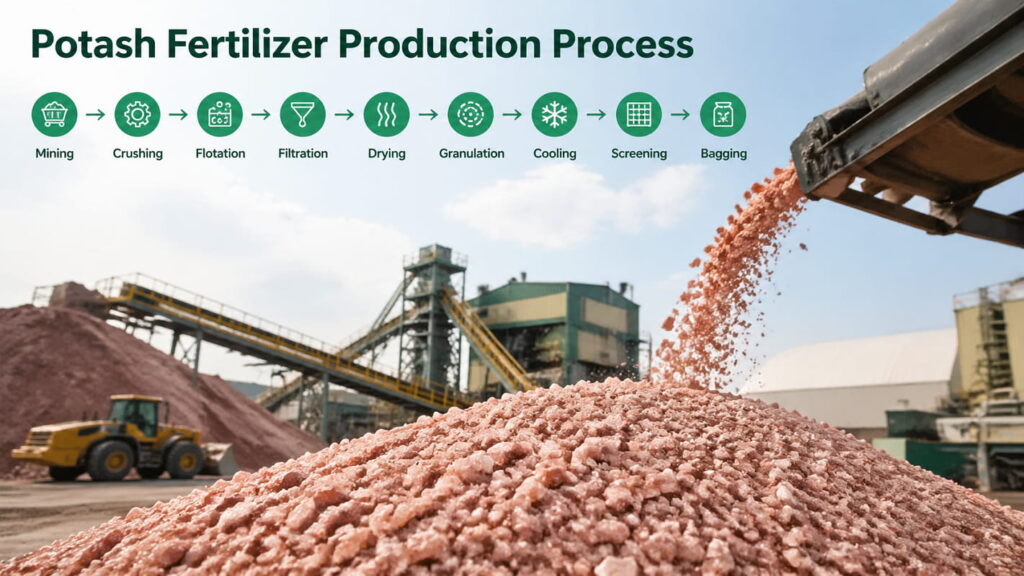
Mining the ore is just step one. The real potash fertilizer production process happens at the mill.
That raw ore? It’s only 20-40% potassium chloride (KCl). The rest is mostly sodium chloride (regular salt) and clay.
Somehow, they need to separate the valuable potash from the worthless salt. And they need to do it cheaply, at massive scale.
Here’s how it works, step-by-step:
Step 1: Crushing and Grinding
The ore comes in chunks. They need it powdered.
Two-stage crushing reduces everything to under 2mm. This “liberates” the individual KCl and NaCl crystals from each other and from clay particles.
Key insight: The crushing has to be dust-controlled. These salts create fine dust that’s both a health hazard and a processing nightmare.
Step 2: Desliming (Scrubbing)
This might be the most underappreciated step.
That powdered ore contains “slimes” – fine clay particles. If you don’t remove them, they interfere with everything that follows.
How? They coat the mineral crystals. They change the chemistry of the flotation process. They’re basically trouble.
So they wash the ore with saturated brine (which dissolves more salt, but not clay). A trommel screen removes the clay slimes.
Personal observation: European potash needs more desliming than North American deposits. The geology just has more clay.
Step 3: Froth Flotation – The “Magic” Step
This is where the engineering gets brilliant.
They use a process called froth flotation to separate KCl from NaCl. And it works because of surface chemistry.
Here’s the simplified version:
1. Add “collector” reagents (usually amines): These chemicals coat the KCl crystals but NOT the NaCl crystals. It’s like giving the potash a special jacket.
2. Blow in air bubbles: The coated KCl attaches to the bubbles. The naked NaCl doesn’t. 3. Skim the foam: The KCl-rich foam floats to the top. They skim it off. The NaCl and remaining impurities sink to the bottom as “tailings.”
They can also do reverse (“anionic”) flotation, where they float the NaCl instead. Depends on the ore.
The bottom line? This one step is why potash is affordable. Without selective flotation, separating these nearly-identical white crystals would be astronomically expensive.
Step 4: Dewatering and Drying
That skimmed foam is wet. Like, 30-40% water.
They use centrifuges to get most of the liquid out. Then, massive rotary drum dryers bake it at around 200°C.
What comes out is fine, powdered potassium chloride. About 95-96% pure.
Step 5: Compaction and Sizing
Powder doesn’t spread well. It cakes. It drifts in the wind.
So they compact it. Heavy rollers press the powder into sheets, which break into granules. Then, screens sort those granules into sizes: standard, granular, soluble.
Farmers care about this more than they realize. Different spreaders need different granule sizes. Get it wrong, and your application uniformity suffers.
Step 6: Glazing and Coating
Finally, they add a tiny amount of oil or anti-caking agent.
Why? To prevent moisture absorption during storage and transport. Without it, potash would turn into solid blocks in humid conditions.
What About Other Potash Fertilizers?
So far, I’ve described the potash fertilizer production process for MOP (potassium chloride). That’s 80% of the market.
But what about the other 20%?
Potassium Sulfate (SOP) Production
SOP is for chloride-sensitive crops: potatoes, tomatoes, tobacco, some fruits.
There are two main production methods:
1. From langbeinite mineral: Mined and processed similarly to sylvinite, but with different chemistry to separate K₂SO₄ from MgSO₄
2. Mannheim Process: Reacting KCl with sulfuric acid at high temperature. More expensive, but used where langbeinite isn’t available.
Potassium Nitrate
Usually made by reacting KCl with nitric acid. Provides both K and N in nitrate form. Premium price, premium product.
Potassium-Magnesium Sulfates
Blends or natural minerals (like langbeinite again) that provide both K and Mg. Great for soils deficient in both.
The Innovation Happening Right Now
The potash fertilizer production process isn’t static. Companies are innovating to:
- Reduce energy use (drying is energy-intensive)
- Improve recovery rates (getting more K from the same ore)
- Minimize environmental impact (tailings management, water use)
- Create enhanced products (like polymer-coated slow-release potash)
One company I’ve been following, ICL, has developed “PotashpluS” – a granule that combines potassium with sulfur, magnesium, and calcium. It’s like a multi-vitamin for crops.
Why this matters: As fertilizer efficiency becomes more critical (for both economics and sustainability), these enhanced products will become more important.
3 Challenges in Potash Production Most People Don’t See
After studying this industry for years, here’s what keeps potash engineers up at night:
Challenge #1: Geology is Variable
No two deposits are identical. The KCl content, the crystal size, the clay types, the impurity profiles – all vary.
That means a potash fertilizer production process that works perfectly in Saskatchewan might need tweaking in Belarus or New Mexico.
Challenge #2: Tailings Management
All that leftover salt and clay? It has to go somewhere.
In some places, they pump it back underground. In others, they store it in surface piles. Environmental regulations are getting stricter everywhere.
Challenge #3: Energy Costs
Drying potash takes heat. Compaction takes electricity. In an energy-intensive industry, price volatility hurts.
Some newer facilities are looking at waste heat recovery, solar pre-heating, and other efficiencies.
How This Affects You as a Grower
You might be thinking: “Interesting, but I just want to buy bagged fertilizer.”
Here’s why understanding the potash fertilizer production process matters:
1. Price fluctuations make sense: When energy prices spike, potash prices follow. When a major mine has issues, supply tightens.
2. You can choose the right product: Understanding MOP vs SOP production helps you understand why SOP costs more, and when it’s worth it.
3. Application issues become clearer: Why does potash sometimes cake? Why do granules vary in size? The answers are in the production process.
4. You appreciate the supply chain: That bag of potash might have traveled from Saskatchewan to Iowa to your local co-op. Understanding the process helps you plan purchases better.
My #1 Tip for Using Potash Fertilizers
Test your soil.
I know, everyone says this. But here’s why it’s critical for potassium:
Potassium doesn’t leach like nitrogen. It builds up in the soil. You can easily over-apply.
And excess potassium can cause nutrient imbalances (like magnesium deficiency).
A proper soil test tells you:
- Current potassium levels
- Cation exchange capacity (how much K your soil can hold)
- Ratios with other cations (like Mg and Ca)
Without a test, you’re guessing. And with today’s fertilizer prices, guessing is expensive.
The Future of Potash Production
Looking ahead to 2026 and beyond, here’s what I’m watching:
Automation and AI: Mines and mills are becoming smarter. Sensors everywhere. Predictive maintenance. Process optimization algorithms.
Sustainability pressures: Carbon footprint tracking. Water recycling mandates. Tailings management innovations.
Product enhancements: More specialty blends. Coatings that improve efficiency. Bio-stimulant combinations.
Geopolitical factors: Most potash reserves are in just a few countries. Supply chain diversification will be a theme.
The potash fertilizer production process that exists in 2030 will likely be more efficient, more sustainable, and more digitally-integrated than today’s.
Bottom Line?
The journey from ancient seabed to fertilizer spreader is one of modern industry’s quiet miracles.
It combines geology, chemistry, mechanical engineering, and logistics into a process that delivers affordable potassium to farms worldwide.
Understanding that potash fertilizer production process doesn’t just make you a more informed grower. It gives you appreciation for an industry that literally feeds the world.
And in my book, that’s worth understanding.
Got questions about potash or fertilizer production? Drop them in the comments. I read every one.


 English
  Spanish
  French
  Russian
  German
  Italian
  Turkish