
Let me ask you a question:
When you see those uniform, granular fertilizers that farmers spread across thousands of acres… have you ever wondered how they’re actually made?
I’ll be honest with you—I used to think fertilizer production was some mysterious industrial magic. Then I dug into the actual DAP fertilizer production process. And what I discovered surprised me.
Here’s the deal:
The DAP fertilizer production process isn’t just about mixing chemicals. It’s a carefully controlled dance of chemistry, engineering, and scale. Get it right, and you produce one of the world’s most efficient phosphorus fertilizers. Get it wrong, and you’re left with subpar product, wasted resources, and unhappy customers.
In this guide, as a professional fertilizer production line manufacturer, let me lead you to dive in the whole DAP fertilizer production process.
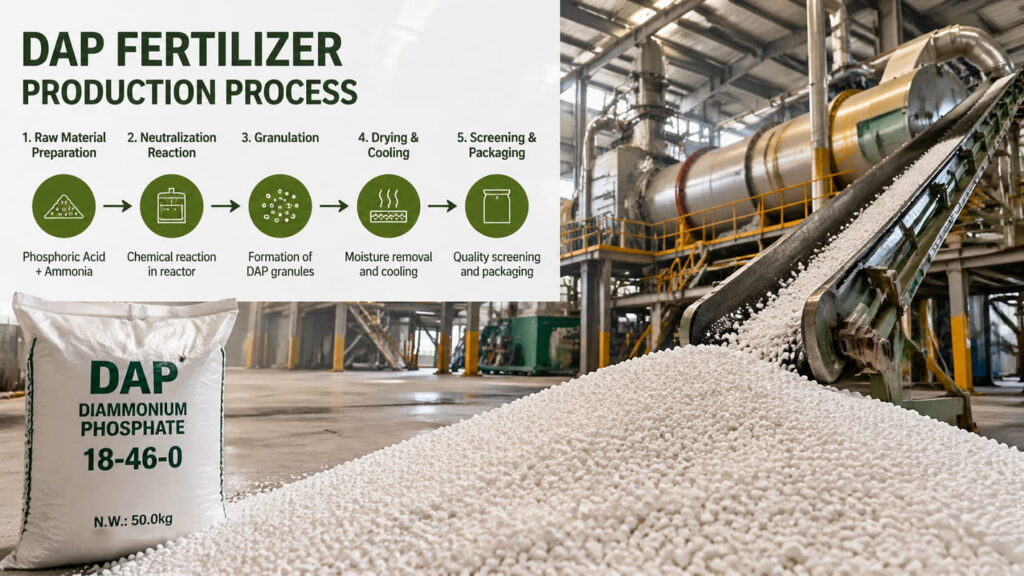
What Is DAP Fertilizer? (And Why It Matters)
DAP stands for Diammonium Phosphate.
It’s the world’s most widely used phosphorus fertilizer. And for good reason.
With an 18-46-0 nutrient grade (18% nitrogen, 46% phosphorus pentoxide), DAP delivers concentrated nutrition in every granule. Farmers love it because it’s highly soluble, predictable, and handles well in everything from broadcast spreaders to irrigation systems.
But here’s the thing:
That perfect 18-46-0 ratio doesn’t happen by accident. It’s the direct result of a precise manufacturing process that’s been refined over decades.
The Raw Materials: What Goes Into DAP
Before we get to the DAP manufacturing steps, you need the right ingredients.
Think of this like baking a cake. You can have the best oven in the world, but if your flour is stale, your cake will flop.
Here’s what goes into every ton of DAP fertilizer:
- 1.5–2 tons of phosphate rock (The primary source of phosphorus)
- 0.4 tons of sulfur (Used to dissolve the phosphate rock)
- 0.2 tons of ammonia (Provides the nitrogen component)
These materials aren’t just tossed together. They undergo specific preparation:
Phosphate rock reacts with sulfuric acid to produce phosphoric acid. That phosphoric acid then becomes the base for the entire DAP fertilizer production line.
Pro Tip: The quality of your raw materials directly impacts your final product grade. I’ve seen facilities with outdated fertilizer production equipment struggle with inconsistent analysis because they compromised on rock quality.
The 5-Step DAP Fertilizer Production Process
This is where things get interesting.
The DAP fertilizer production process follows a logical, multi-stage flow. Miss one step, and your entire batch can be affected.
Step 1: Pre-Neutralization (Slurry Formation)
Here’s where the chemical reaction begins.
Phosphoric acid and ammonia meet in reaction tanks (called pre-neutralizers). The reaction is straightforward on paper:
H₃PO₄ + 2NH₃ → (NH₄)₂HPO₄
But in practice? Temperature control is everything.
The reaction generates significant heat (reaching 150–180°C/302–356°F). This heat actually helps evaporate excess water from the slurry. Facilities use process water from tail gas scrubbers to control the temperature and keep the slurry pumpable.
The ideal slurry has 16–20% moisture—enough to flow smoothly but not so wet that it creates downstream problems.
Step 2: Granulation (Where Particles Form)
Now we turn liquid slurry into solid granules.
The slurry gets pumped to a rotary drum granulator (sometimes called an ammoniator-granulator). Here, it’s sprayed over a rolling bed of recycled material.
What’s in this recycle bed?
- Undersized granules from screening
- Crushed oversized particles
- Dust collected from cyclones
- Some on-size product granules
Simultaneously, additional liquid ammonia is often sparged into the granulator to complete the acid neutralization. This completes the conversion to diammonium phosphate.
The physical action here is fascinating: dry recycle particles get coated with slurry, then agglomerate and round into uniform spheres through tumbling action.
Step 3: Drying (Moisture Removal)
Fresh granules leaving the granulator contain about 20% moisture. That’s way too high for storage or bagging.
So they enter a rotary dryer.
Hot air (205–324°C/401–615°F) flows co-currently with the granules, reducing moisture to approximately 1%. This isn’t just about drying—the tumbling action further polishes and hardens the granules.
I’ve toured facilities where dryer temperature variations of just 10°C created significant quality differences. Consistent heat is non-negotiable.
Step 4: Cooling and Screening (Size Classification)
Hot granules straight from the dryer would cake during storage. So they move to a rotary cooler.
Counter-current cool air brings granule temperature down to about 54°C (129°F). This reduces ammonia loss and prevents agglomeration in storage.
Then comes screening.
Vibrating screens separate granules into three streams:
- Oversize (+6 mesh): Sent to chain mills for crushing
- Undersize (-16 mesh): Returned directly to granulator as recycle
- On-size product (2–4 mm): The gold standard—sent to product surge bins
This closed-loop recycling system is why modern DAP fertilizer manufacturing achieves such high efficiency. Almost nothing is wasted.
Step 5: Scrubbing and Emission Control
This is the invisible but critical part of the DAP fertilizer production process.
Vent air from the reactor, granulator, dryer, and cooler contains ammonia fumes and dust. It gets routed through primary scrubbers where phosphoric acid captures unreacted ammonia.
Then, a tail gas scrubber provides final cleaning with recirculated water before exhaust vents to atmosphere.
Why does this matter? Beyond environmental compliance, recovering ammonia improves your nitrogen efficiency—directly impacting your bottom line.
Equipment Deep Dive: The Machines That Make It Happen
You can’t talk about DAP fertilizer production without discussing equipment.
During my research, I examined several fertilizer manufacturing lines. The most efficient operations share common equipment choices:
Rotary Drum Granulators
- Ideal for large-scale production (15–30 t/h capacity)
- Wet granulation method using steam or water
- High balling rate (93%+)
Pan Granulators (Disc Pelletizers)
- Better for small to medium operations (0.8–1.2 t/h)
- Allow discontinuous operation with multiple discharge ports
- Excellent for product development and testing
Double Roller Granulators
- Dry granulation—no drying needed afterward
- Lower capacity (6–8 t/h) but simpler operation
- Create different granule shapes with interchangeable roller sheets
Pro Tip: Your choice of fertilizer granulator dictates your downstream needs. Rotary and pan granulators require dryers and coolers. Roller granulators don’t. Factor this into your capital investment.
Advanced Considerations: Beyond Basic Production
If you’re just copying a standard DAP fertilizer production flow sheet, you’re leaving value on the table.
Here’s what top-performing facilities do differently:
1. They Optimize Slurry Chemistry The reactor isn’t just making DAP. It typically produces a mixture of monoammonium phosphate (MAP) and DAP. Why? Because this mixture is more soluble and pumps at lower moisture than pure DAP.
The ammonia-to-phosphoric acid mole ratio is carefully controlled:
- Around 0.6 for MAP
- Around 1.4 for DAP
2. They Master Recycle Management The recycle ratio (recycle:product) significantly impacts granulator performance. Too little recycle, and you get uneven coating. Too much, and you reduce capacity. Successful operations continuously monitor and adjust this balance.
3. They Implement Rigorous Quality Control Common problems have straightforward diagnostics:
- High moisture? Increase dryer heat
- Low nitrogen/phosphorus? Adjust ammonia or phosphoric acid flows
- All low analysis? Decrease filler flow
The best facilities catch these issues in real-time, not at final inspection.
The Future of DAP Production (2026 Outlook)
Looking ahead to 2026, I see three trends shaping DAP fertilizer manufacturing:
1. Digital Integration IoT sensors throughout the production line will enable predictive maintenance and real-time optimization. Imagine knowing your granulator needs bearing replacement before it fails during peak season.
2. Sustainability Focus Water recycling will become standard. Energy recovery from exothermic reactions will improve. Carbon footprint tracking will influence purchasing decisions.
3. Flexibility Demands Plants will need to switch between DAP, MAP, and NPK production more rapidly. Modular equipment designs will facilitate this agility.
Getting Started: Your Action Plan
If you’re considering entering DAP fertilizer production, here’s my recommended approach:
1. Start with a pilot line before full-scale investment. Test your specific phosphate rock with your chosen process.
2. Choose equipment for tomorrow’s needs, not just today’s. Can your granulator handle different formulations? Is there room for expansion?
3. Build relationships with raw material suppliers early. Consistent phosphoric acid quality matters more than saving $5/ton.
4. Invest in training before startup. The most advanced fertilizer production equipment is useless without skilled operators.
5. Plan for environmental compliance from day one. Retro-fitting scrubbers costs 3-5x more than installing them initially.
Bottom Line?
The DAP fertilizer production process combines precise chemistry with mechanical engineering. Success requires equal attention to both.
Master the reaction conditions. Optimize your granulation. Control your emissions. And never stop improving.
Because in the end, it’s not just about making fertilizer. It’s about nourishing crops that feed communities. And that’s worth doing right.


 English
  Spanish
  French
  Russian
  German
  Italian
  Turkish