
Ever stop and think how a plain bag of 15-15-15 becomes smooth, round granules that spread evenly in the field and give crops what they need, without a bit going to waste?
That’s exactly what the compound fertilizer production process is all about.
Compound fertilizer isn’t just mixed and bagged like a salad. It’s chemically or physically engineered so every single granule contains balanced nitrogen (N), phosphorus (P), and potassium (K) — exactly what your soil or crop needs. And in 2026, with bigger farms and tighter margins, getting this process right can mean the difference between decent yields and record-breaking ones.
I’ve torn apart hundreds of plant manuals, walked factory floors, and checked the numbers that actually show up in daily runs. Now, as a professional fertilizer production line manufacturer, I’ll take you through how compound fertilizer is really made, start to finish, from raw inputs to sealed bags. No fluff. No buzzwords. Only the steps that matter on the line.
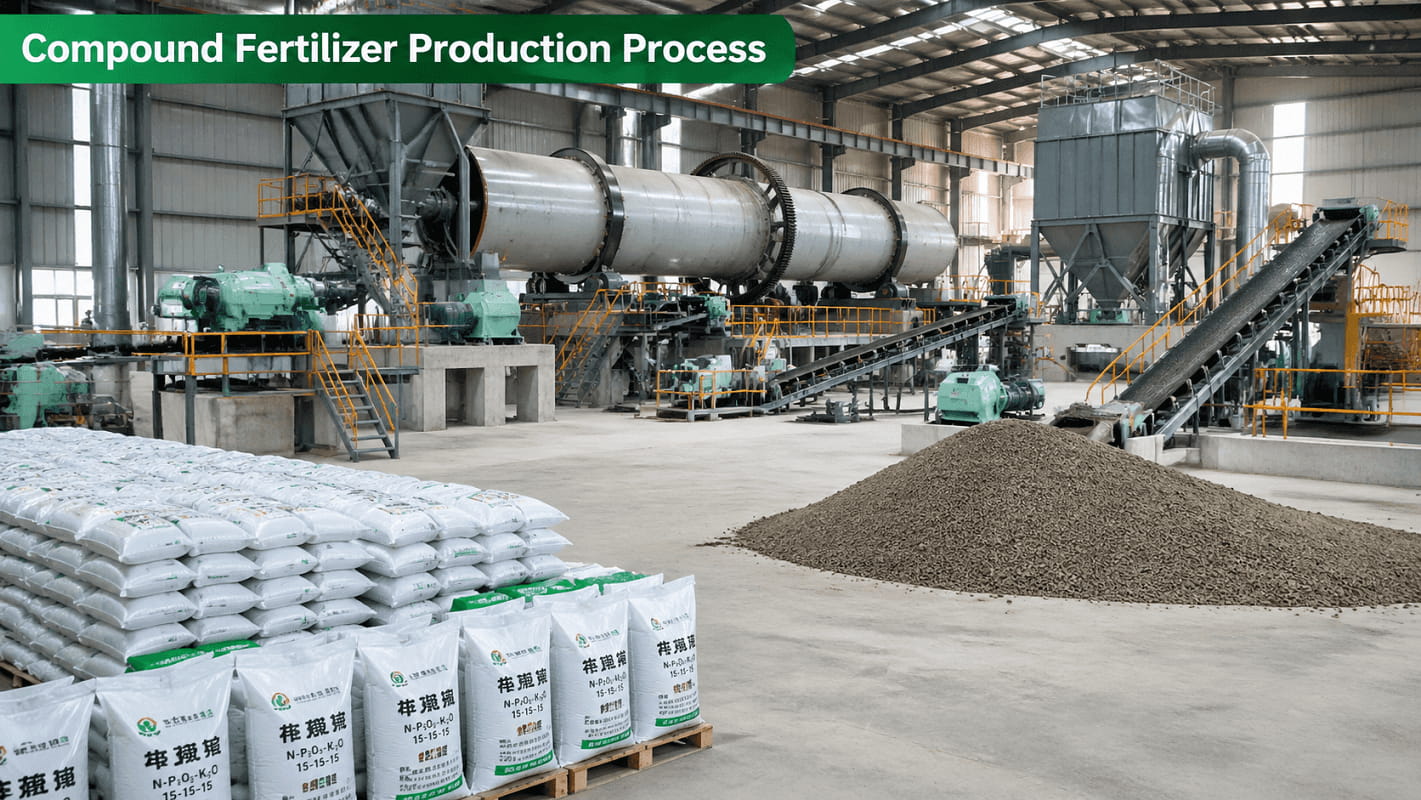
What Exactly Is Compound Fertilizer?
Quick refresher (because most people get this mixed up with blends):
Compound fertilizer contains at least two of the primary nutrients (N, P, K) in each individual granule. It’s made either by chemical reaction or precise physical blending.
Unlike BB (bulk blend) fertilizers where you just toss urea, DAP, and MOP into a mixer and hope the nutrients stay even, true compound fertilizers lock everything together so segregation doesn’t happen in the spreader.
Farmers love them because one pass across the field gives balanced nutrition. Manufacturers love them because they command better prices and store better. Win-win.
Raw Materials That Make It All Happen
Every compound fertilizer production process starts with the right ingredients. Here’s what actually goes into the mix:
Nitrogen sources
- Urea (N ≥46%) — most popular because it’s cheap and high-analysis
- Ammonium sulfate, ammonium nitrate, ammonium chloride
Phosphorus sources
- Monoammonium phosphate (MAP), diammonium phosphate (DAP)
- Superphosphate or triple superphosphate
Potassium sources
- Potassium chloride (MOP) — cheapest
- Potassium sulfate (SOP) — for chloride-sensitive crops
Plus fillers, micronutrients (zinc, boron), and sometimes anti-caking agents.
Pro Tip: The quality of these raw materials directly decides how smooth your granulation will be. Cheap, lumpy urea? Expect dust and uneven granules.
8 Steps of Compound Fertilizer Production Process
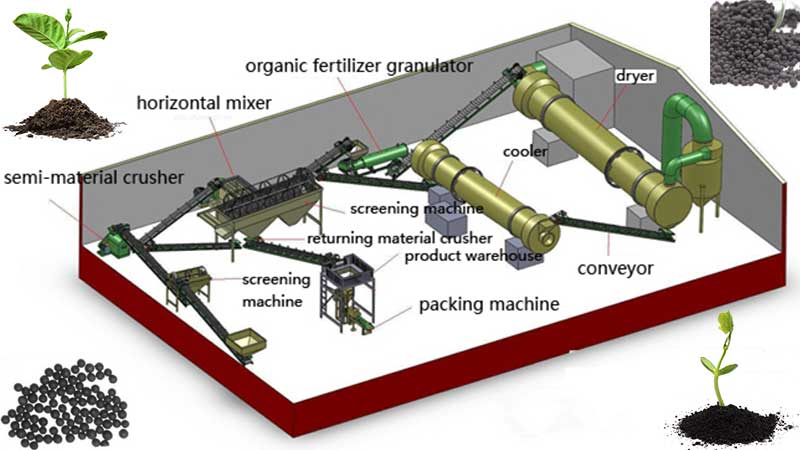
No matter which granulation method you choose, the compound fertilizer production process follows the same basic flow. Here’s the exact sequence used in 90% of modern plants:
1. Raw Material Preparation
Weigh, crush, and screen everything to uniform particle size. Big chunks ruin granulation.
2. Mixing
Double-shaft paddle mixers or drum mixers blend the powders until the coefficient of variation is under 5%. Uniformity here is everything.
3. Granulation (the heart of the process)
This is where powders turn into pellets. Different methods = different results (more on that below).
4. Drying
Rotary dryers blast hot air to drop moisture below 2-3%. Wet granules = caking disaster.
5. Cooling
Ambient air hardens the granules and prevents them from sticking together later.
6. Screening
Vibrating screens separate on-size (usually 2–4.75 mm), oversize (crushed and recycled), and fines (sent back to the mixer).
7. Coating
A thin layer of oil, wax, or anti-caking powder stops hygroscopic granules from turning into bricks in humid storage.
8. Packaging
25 kg, 50 kg, or 1000 kg big bags — weighed, sealed, and ready to ship.
Sound simple? It is — on paper. The magic (and the headaches) happen in step 3.
6 Popular Granulation Methods Compared
Here’s where things get interesting. The compound fertilizer production process isn’t one-size-fits-all. Different methods suit different formulas, budgets, and markets.
| Method | Best For | Capacity | Pros | Cons | Typical NPK Examples |
|---|---|---|---|---|---|
| Steam/Drum Granulation | Large-scale NPK | Very high | Cheap, high output, durable granules | Lower water solubility, can powder | 15-15-15, 20-10-10 |
| High Tower Granulation | High-nitrogen formulas | High | Glossy, fast-dissolving, low moisture | High biuret risk, max ~15% P | 30-10-10, 28-5-5 |
| Spray Drum Granulation | High-N, urea-based | Medium-high | Uniform size, good anti-caking | Best for N ≥20%, lower P solubility | 25-5-5, 22-8-8 |
| Ammoniation Granulation | Sulfur-based, high quality | Medium | 95%+ water-soluble P, bright color | More complex chemistry | 15-15-15 sulfur-based |
| Disc/Pan Granulation | Small batches, specialty | Low | Easy to monitor, uniform particles | Not for high-volume | Specialty micronutrient |
| Bulk Blending (BB) | Custom low-cost blends | Very high | Lowest cost, flexible | Risk of segregation | Any on-farm blend |
Steam/Drum Granulation — The Workhorse
This is still the most common compound fertilizer production process worldwide. Powders + steam/water in a rotating drum create “liquid bridges” that glue particles together. Low investment, high capacity, short plant build time. Downside? Granules can be softer and less water-soluble.
High Tower Granulation — The Shiny Premium Option
Molten urea (or mix) sprayed from a tall tower cools and forms glossy, crystalline granules with tiny pores. Looks fantastic on the shelf. Perfect for high-nitrogen formulas. But you need ultra-pure raw materials and you’ll fight biuret levels near the 1.5% legal limit.
Spray Drum & Ammoniation Granulation
These are basically upgraded drum processes. Spray granulation skips crushing urea by piping molten urea straight from the urea plant. Ammoniation uses pipe reactors for fast, complete reactions — giving you higher nitrogen (16%+) and 95% water-soluble phosphorus. Great for crops that need quick uptake.
Disc Granulation & BB Fertilizer
Disc granulation is simple and perfect for small producers. BB is just precise blending — no chemical reaction — but you must match particle size and density perfectly or you’ll get separation in the bag.
Real-World Data That Matters in 2026
Industry reports show drum granulation still holds ~60% market share in Asia because of its balance of cost and output. High-tower lines dominate high-concentration premium markets in Europe and North America because buyers pay extra for that glossy look and fast solubility.
Water solubility is king: farmers using ammoniation or high-tower products often see 10-15% higher nutrient uptake compared with basic drum granules in the same conditions.
Pro Tips I Wish I Knew Sooner
- Recycle smart: Keep your oversize and fines loop tight — it can boost your finished product yield by 15-20%.
- Coating is non-negotiable: In humid 2026 summers, uncoated high-urea granules turn into rocks. One thin wax layer changes everything.
- Monitor biuret: Especially in high-tower and spray processes. Anything over 1.5% risks seedling burn.
- Match the method to the formula: High P? Skip high tower. High N? High tower or spray wins.
- Automation pays: Modern lines with electronic batching and PLC controls cut labor and CV (variation) dramatically.
Common Problems & Quick Fixes
- Uneven granules → Check steam/water addition rate and drum speed.
- Caking in storage → Increase cooling time + better coating.
- Low water solubility → Switch to ammoniation or add more MAP/DAP.
- Dust everywhere → Install proper dedusting cyclones and bag filters.
The Bottom Line?
The compound fertilizer production process is part science, part engineering, and part art. Choose the right granulation method for your target NPK ratio and market, nail the raw material prep and drying steps, and you’ll produce consistent, high-value fertilizer that farmers actually want to buy again.
Whether you’re running a 10-ton-per-hour drum line or a shiny new high-tower plant, the fundamentals stay the same: uniform mixing, controlled agglomeration, proper drying/cooling, and smart coating.
Master the compound fertilizer production process and you don’t just make fertilizer — you make money while helping crops thrive.
Got questions about which method fits your setup best? Drop them below. I answer every single one.


 English
  Spanish
  French
  Russian
  German
  Italian
  Turkish