
Ever wondered how those white pellets that feed half the world’s crops are made?
Here’s the deal:
The urea fertilizer production process transforms simple gases into the most widely used nitrogen fertilizer on the planet. And today, as a professional fertilizer production line manufacturer, I’m going to break down exactly how it works.
(Spoiler alert: It’s more fascinating than you’d think.)
Quick Summary:
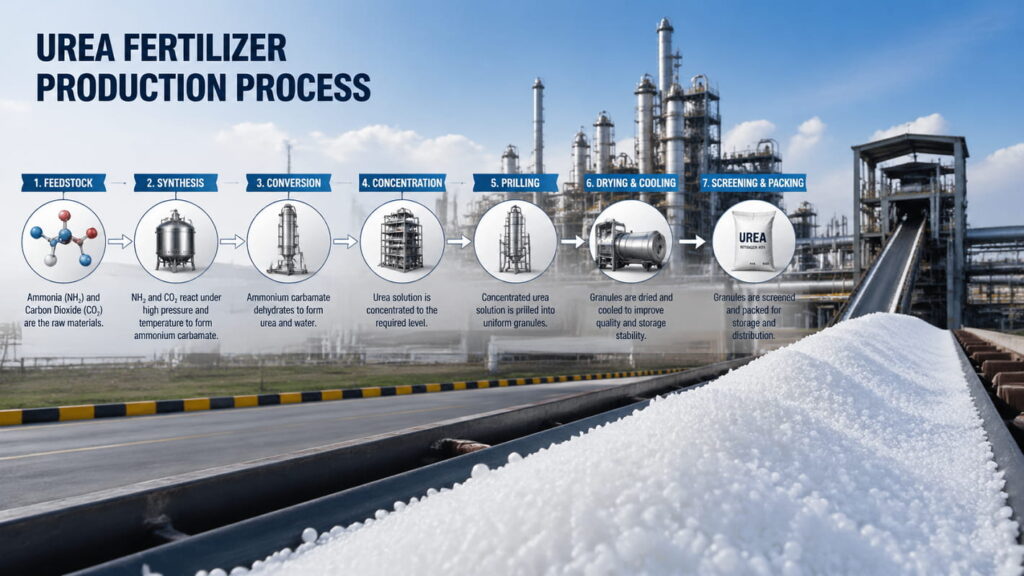
1. Urea production converts ammonia and CO₂ into the world’s most concentrated solid nitrogen fertilizer through two linked reactions: rapid formation of ammonium carbamate and slower conversion to urea and water.
2. Synthesis takes place in a high-pressure stainless-steel reactor at 180–200°C and 130–240 bar, where single-pass CO₂ conversion is typically 50–80%.
3. Unconverted ammonia and CO₂ are recovered through staged high- and low-pressure decomposition and recycled to the synthesis tower.
4. Concentration uses vacuum evaporators to raise a ~70% urea solution to molten urea of about 99.7% purity, and solidification follows by prilling or granulation.
The Raw Materials You Need
Before we dive into the actual process, let’s talk ingredients.
You only need two things:
- Ammonia (NH₃)
- Carbon dioxide (CO₂)
That’s it.
The beauty? CO₂ is actually a byproduct of ammonia production. So if you’re making ammonia, you’ve already got half your raw materials sorted.
Pretty neat, right?
The Chemistry Behind Urea Production
Now for the fun part.
The urea fertilizer production process happens in two main reactions:
First reaction:
2NH₃ + CO₂ → NH₂COONH₄ (ammonium carbamate)
This happens fast. Like, really fast. And it releases a ton of heat.
Second reaction:
NH₂COONH₄ → CO(NH₂)₂ + H₂O
This one’s trickier. It’s slower and actually absorbs heat.
Here’s the kicker:
Getting these two reactions to work together efficiently is what separates mediocre urea plants from world-class operations.
Urea Fertilizer Production Process: Step-by-Step
Step 1: The Synthesis Tower
This is where the magic happens.
Ammonia and CO₂ enter a massive stainless steel reactor at:
- Temperature: 180-200°C
- Pressure: 130-240 bar
(That’s about 200 times atmospheric pressure!)
Inside, those two reactions I mentioned? They’re happening simultaneously.
But here’s the thing:
Only about 50-80% of the CO₂ converts to urea in a single pass. The rest? We’ll deal with that in a minute.
Step 2: Decomposition and Separation
Remember that unconverted stuff?
Now we need to break it down and recycle it. This happens in stages:
- High-pressure decomposition (17-25 bar)
- Low-pressure decomposition (2-5 bar)
Each stage strips out more ammonia and CO₂, which gets sent back to the synthesis tower.
Nothing goes to waste.
Step 3: Concentration
At this point, you’ve got a urea solution that’s about 70% urea and 30% water.
Not good enough.
So we concentrate it using vacuum evaporators. The goal? Get it up to 99.7% pure molten urea.
Pro tip: This is where energy efficiency really matters. Modern plants use multi-stage evaporation to minimize steam consumption.
Step 4: Solidification (The Grand Finale)
Here’s where liquid urea becomes the product farmers actually use.
Two main options:
Prilling:
- Spray molten urea from the top of a 50-80 meter tower
- Droplets fall through cooling air
- Form into small spherical pellets (1-2.4mm diameter)
Granulation:
- Spray urea onto seed particles in a rotating drum
- Build up layers until you get larger granules (2-4mm)
- More expensive but creates a superior product
I’ve seen both processes in action. Watching urea droplets turn into perfect little spheres as they fall? It’s oddly satisfying.
Modern Technology Innovations
The urea industry hasn’t stood still.
Here’s what’s changed in 2026:
CO₂ Stripping Technology
Instead of using heat alone to decompose ammonium carbamate, modern plants use excess CO₂ as a stripping agent. This cuts energy use by up to 35%.
Pool Condenser Design
New reactor designs submerge reaction tubes in boiling water. Result? Better temperature control and 10% higher conversion rates.
Integrated Heat Recovery
Every bit of waste heat gets captured and reused. Some plants now operate with near-zero external steam requirements.
The bottom line?
Today’s urea plants use half the energy they did 30 years ago.
Quality Control Essentials
Making urea is one thing. Making good urea is another.
Key quality parameters:
- Nitrogen content: 46.0% minimum
- Biuret: Less than 1.0% (it’s toxic to plants)
- Moisture: Under 0.3%
- Particle size distribution: Consistent sizing
Here’s what I find fascinating:
Biuret forms when urea overheats. So temperature control isn’t just about efficiency – it directly impacts product quality.
Environmental Considerations
Let’s address the elephant in the room.
Urea production does have environmental impacts:
- Energy intensive (uses lots of natural gas)
- Produces CO₂ emissions
- Potential for ammonia releases
But here’s the thing:
Modern plants are getting cleaner. Much cleaner.
New developments include:
- Carbon capture integration
- Renewable energy adoption
- Near-zero emission designs
Some facilities in 2026 are even carbon-neutral.
Economic Factors
The economics of urea production are fascinating.
Your main costs:
- Natural gas (60-80% of total cost)
- Capital equipment
- Labor and maintenance
But location matters. A lot.
Plants near cheap natural gas sources have a massive advantage. That’s why you see huge production in the Middle East and Russia.
Fun fact: Transportation can cost more than production for some markets.
Common Urea Fertilizer Production Challenges
Running a urea plant isn’t always smooth sailing.
Major headaches include:
Corrosion
Ammonium carbamate is nasty stuff. It eats through regular steel like acid. That’s why reactors use special stainless steel or titanium.
Crystal Formation
Urea loves to crystallize in the wrong places. I’ve seen entire pipe sections blocked solid.
Energy Balance
Getting the hot reaction and cold reaction to balance perfectly? It’s an art form.
The solution?
Experienced operators and really good process control systems.
Future of Urea Production
Where’s the industry headed?
I’m seeing three major trends:
- Green Ammonia Integration
Using renewable energy to make ammonia means carbon-neutral urea. It’s happening already in small plants. - Advanced Catalysts
New catalysts could boost conversion rates past 90%. That’s game-changing efficiency. - Modular Design
Smaller, prefab plants that can be deployed anywhere. Perfect for local production.
The next decade is going to be interesting.
Optimizing Your Understanding
So there you have it.
The urea fertilizer production process might seem complex, but it really boils down to combining two gases under extreme conditions and carefully managing the results.
What fascinates me most?
How we’ve taken a process discovered over 100 years ago and continuously refined it. Each improvement might only save 1-2% energy, but multiply that by global production volumes?
The impact is huge.
Whether you’re a farmer wondering how your fertilizer is made, an engineer looking to understand the process, or just someone curious about industrial chemistry – I hope this guide gave you the insights you were looking for.
The urea fertilizer production process remains one of the most important industrial processes on Earth. And now you know exactly how it works.


 English
  Spanish
  French
  Russian
  German
  Italian
  Turkish