
Let me ask you something: did you know the average U.S. household throws away 30% of its food? That’s not just wasted groceries—it’s wasted opportunity. Here’s the deal: those banana peels, coffee grounds, and yard clippings are gold mines for your garden.
In this guide, as a professional fertilizer production line manufacturer, I’ll share how to produce fertilizer from organic waste using battle-tested methods—whether you’re in a tiny apartment or running a commercial farm.

Why Your Garbage Shouldn’t Go to Waste
Every year, landfills drown under 63 million tons of food scraps. Meanwhile, your plants crave nutrients. Organic fertilizer closes this loop. Benefits?
- Saves $200/year per household (USDA, 2025)
- Slashes methane emissions by up to 95% vs. landfills
- Creates soil that retains 7x more water than synthetic-fed dirt
- Eliminates chemical runoff contaminating waterways
Sound good? Let’s get your hands dirty.
How to Produce Fertilizer from Organic Waste
Aerobic Composting: Your Garden’s Fast Track to “Black Gold”
Best for: Home gardeners with outdoor space Time: 3–6 months
Here’s how to transform scraps into crumbly, nutrient-packed humus:
1. Location Matters: Pick a dry, shady spot (no swampy zones). Use a bin or open pile. 2. Layer Like a Pro (The 3:1 Rule):
Browns (Carbon):
- Dry leaves
- Cardboard (uncoated)
- Straw
Greens (Nitrogen):
- Vegetable peels
- Coffee grounds
- Fresh grass clippings
Pro Tip: Too many greens = stink. Too many browns = slow decay. Stick to a 3:1 brown-green ratio.
3. Moisture Check: Squeeze a handful. It should feel like a damp sponge—not dripping. 4. Aerate Weekly: Turn the pile with a pitchfork. Oxygen fuels thermophilic bacteria that heat your pile to 150°F (65°C), killing weed seeds. 5. Cure Patiently: When it’s dark, earthy-smelling, and unrecognizable, let it rest 4 weeks. Voilà—plant steroids!
In my experience, skipping step 4 is the #1 reason compost fails. Turn it religiously.
Vermicomposting: Silent Superworkers for Small Spaces
Best for: Apartments, offices, classrooms
Time: 2–3 months
Red Wigglers (Eisenia fetida) eat their weight daily, turning kitchen scraps into nutrient-dense castings. Here’s the drill:
1. Bin Setup:
- Drill holes in a plastic tub
- Fill ½ with damp shredded newspaper
2. Worm Welcome: Add 1 lb of Red Wigglers (not earthworms—they’ll die!).
3. Feeding Strategy:
- Bury scraps under bedding weekly
- Avoid citrus, meats, oils
4. Harvesting Gold:
- Push finished compost to one side
- Add fresh food to the other
- Worms migrate—scoop castings freely
Bokashi Fermentation: Instant Plant Fuel in 2 Weeks
Best for: Balcony gardeners, urgent nutrient boosts
Time: 2–4 weeks
No space? No problem. This anaerobic method brews concentrated liquid fertilizer:
1. Bucket Brewing:
- Layer waste (fruit/veggie scraps) in an airtight bucket
- – Sprinkle Bokashi bran (contains effective microorganisms)
2. Press & Seal: Compress scraps; close lid tightly. No oxygen = no rotting!
3. Drain Liquid: Tap the spigot daily. Dilute 1:10 with water before use.
4. Bury Solids: After 2 weeks, bury fermented scraps—they decompose in 3 days.
Pro Tip: This handles meat and dairy—normally compost no-nos.
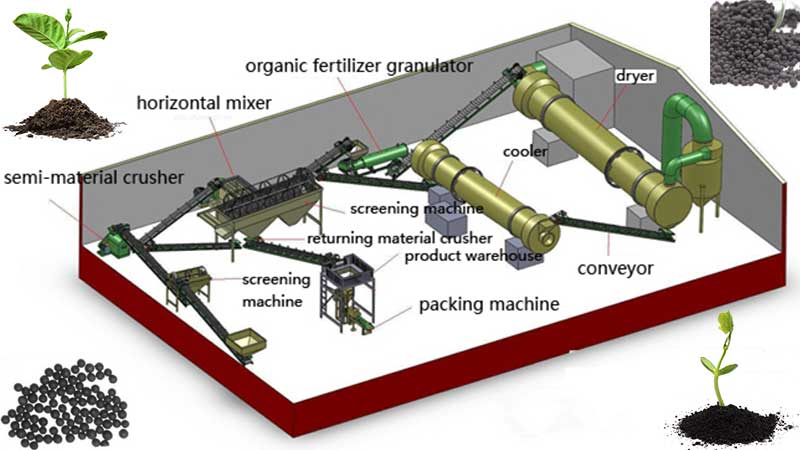
Industrial-Scale Fertilizer Production (For Farms & Businesses)
Best for: Commercial operations with heavy waste volume Process: Mechanized precision meets massive output.
| Step | Equipment Needed | Function |
|---|---|---|
| Shredding | Industrial shredder | Increases surface area for fast breakdown |
| Fermentation | Windrow turner or reactor | Controlled decomposition (kills pathogens) |
| Granulation | Pellet machine | Compacts powder into easy-spread pellets |
| Quality Control | Lab testing kit | Verifies NPK (Nitrogen, Phosphorus, Potassium) levels |
Key Stat: Granulated organic fertilizer sells for $200-$600/ton wholesale (FarmBiz Quarterly, 2025).
What to Feed Your Fertilizer Factory (And What to Starve)
| YES! (Compost These) | NEVER! (Avoid These) |
|---|---|
| Greens (Nitrogen): | Meat/fish (attracts pests) |
| – Fruit peels | Dairy products |
| – Coffee grounds | Oils/grease |
| Browns (Carbon): | Pet waste (pathogens) |
| – Dry leaves | Diseased plants |
| – Untreated sawdust | Glossy cardboard |
The bottom line? A balanced diet makes healthy fertilizer.
Troubleshooting Stinky Situations
Problem: Smells like a landfill.
Fix:
- Turn pile more often
- Add browns (carbon)
- Check moisture—too wet? Mix in leaves.
Problem: Pests setting up camp. Fix: – Bury food scraps under 6″ of bedding – Install hardware cloth around bins
Beyond Fertilizer: How This Changes Everything
When you master how to produce fertilizer from organic waste, you’re not just gardening—you’re fighting climate change.
- Every ton of compost prevents 1.5 tons of CO2 emissions (EPA, 2025)
- Farms using organic fertilizer see 19% higher yields after 5 years (Rodale Institute)
Action Step: Start a 5-gallon bucket Bokashi system today. In 30 days, you’ll pour liquid gold on your plants.
Ready to transform waste into wealth? That’s how to produce fertilizer from organic waste—no labs, no toxins, no wasted potential. Your garden (and the planet) will thank you.


 English
  Spanish
  French
  Russian
  German
  Italian
  Turkish