
- Key Takeaways
- Equipment for a 1–20 t/h mini‑urea plant runs $13,000–$200,000+, but total CAPEX easily doubles when you add land, construction, utilities, and raw materials (which require cash upfront).
- True small‑scale production usually means processing pre‑made urea (blending, granulating, coating) — synthesizing from ammonia is vastly more expensive and complex.
- Energy consumption is a major ongoing cost (100–500 kWh per ton), and unstable power may force you to buy a backup generator.
- The safest entry path: start with a powder line ($30,000–$45,000 for 1–5 t/h), then scale to granulation and automation as you prove the business.
If you are a farmer, or you are running a small agricultural supply company. You’ve got this idea: “Why don’t I just produce my own urea fertilizer? Cut out the middleman. Save some serious cash.”
It’s not as simple as you think. But it’s also not impossible.
Today, as a professional fertilizer production line manufacturer, I’m going to break down the real small scale urea production plant cost. Not the fluffy marketing numbers. Not the “call us for a quote” runaround. The actual, ground-level figures you need to know if you’re serious about getting into this game.
Let’s dive in.
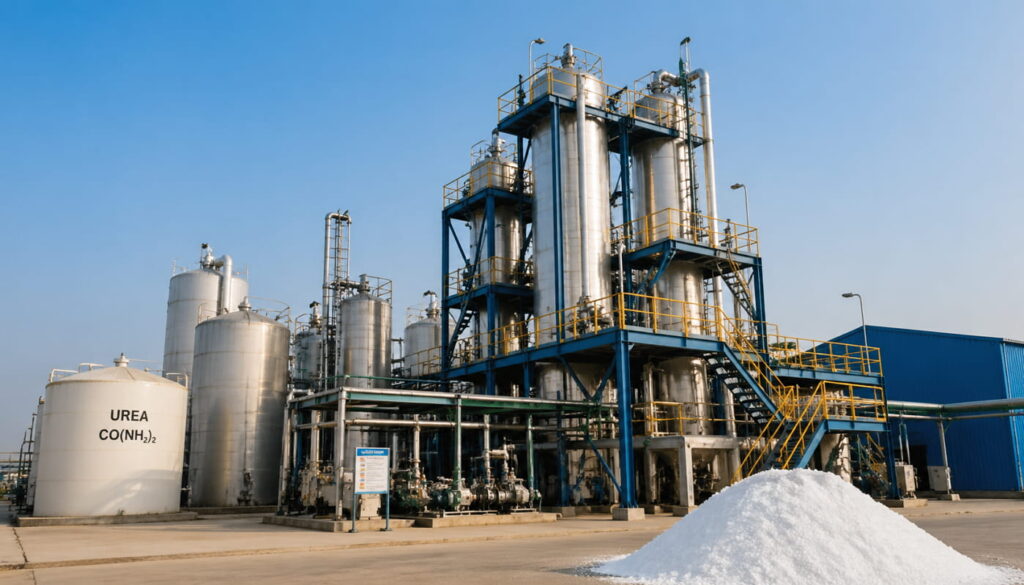
What is a Small Scale Urea Production Plant
We’re NOT talking about building a mini version of those massive industrial complexes you see in the Gulf or China. You know, the ones that cost BILLIONS and produce 1 million tons per year. Nope.
We’re talking about small-scale, mini-urea production plants in the range of 1-20 tons per hour.
And here’s the kicker: most of these “urea plants” aren’t actually producing urea from scratch. They’re focused on fertilizer processing, blending, or prilling rather than full-scale ammonia-urea synthesis.
(More on that in a minute — because this distinction will save you a TON of money.)
Small Scale Urea Production Plant Cost
Let me give you the quick answer first, then we’ll unpack it.
For basic equipment, you’re looking at $13,000 to $45,000.
That’s the range for a legitimate small-scale operation.
But — and this is a BIG but — if you want something fully automatic, specialized, or higher capacity, you need to budget $50,000 to well over $200,000.
Here’s a breakdown that’ll give you some clarity:
| Plant Type | Cost Range |
|---|---|
| Mini-Urea Plant (1-20 t/h, basic) | $13,300 – $43,000 |
| With Coating Technology | $25,200 – $39,200 |
| Basic Formulation Unit | $6,400 – $10,200 |
| Simple Packing/Bagging Setup | $180 – $360 |
Pro Tip: Notice how the packing equipment is dirt cheap? That’s not a typo. But here’s the thing — you need something to actually PACK. And that something is the expensive part.
Key Cost Factors of Small Scale Urea Production Plant
1. Capacity & Type
This is obvious, right? Bigger plant = more money.
But here’s what’s NOT obvious:
A 1 ton/hour plant and a 20 ton/hour plant might look similar on paper. In reality? The 20 ton/hour unit could easily cost 3-4x more.
Why? Engineering. Support structures. Feed systems. The works.
Mini-urea plants (1-20 T/h) cost roughly $13,300–$43,000, while specialized, high-efficiency, or smaller simple systems range from $320 to $15,000.
2. Technology & Automation
This is where things get interesting.
You can go fully manual. Or you can go fully automatic with coating technologies.
Guess what? Fully automatic mini-urea plants with coating technologies run $13,300 to over $39,000.
Is it worth it?
In my experience? Yes. Especially if you’re planning to sell to commercial farms. They expect consistent quality. Automation delivers that.
3. The “Compound Fertilizer” Confusion
Here’s something that tripped me up when I first started researching this space:
Many “urea plants” are actually compound NPK fertilizer plants.
They get lumped together because urea is a key ingredient in NPK blends. But they’re NOT the same thing.
Small-scale compound NPK fertilizer plants can cost between $30,000 and $200,000, depending on the complexity of the granulation process.
So if someone quotes you $30K for a “urea plant,” ask: “Is this actually producing urea, or is it blending it?”
4. The Hidden Costs (This is the Important Part)
Here’s the deal:
The equipment cost is just the beginning.
When calculating your small scale urea production plant cost, you NEED to factor in:
- Land (more on this in a sec)
- Construction (you need a building, foundation, etc.)
- Utility connections (power, water, maybe gas)
- Regulatory licenses (don’t skip this — fertilizer production is regulated for a reason)
- Raw materials (urea doesn’t magically appear)
- Labor (even automated plants need people)
These can EASILY double or triple your total capital expenditure (CAPEX).
Real Examples of Small Scale Urea Production Plant Cost
I’m a big fan of concrete numbers. Theory is great. Real examples? That’s where the learning happens.
Here are actual cost breakdowns for small-scale operations:
Mini-Urea Plant (1-20 t/h)
- Basic setup: $13,300
- Fully automated: $43,000
Small-scale Urea Fertilizer Plant with Coating
- Range: $25,200 – $39,200
Basic Urea Formulation Unit
- Just $6,400 – $10,200
Simple Urea Packing/Bagging
- $180 – $360
Notice something? The packing equipment is cheap. The formulation unit is affordable. But once you add coating and full automation, the price jumps.
The Reality Check You Need
Here’s what I tell everyone who asks me about this:
For a truly small-scale operation, focusing on formulation and bagging/coating of pre-produced urea is WAY more cost-effective than starting from raw chemical feedstock (ammonia).
Why?
Because ammonia production is HARD. It’s energy-intensive. It’s dangerous. And it requires massive infrastructure.
Unless you have millions to burn and a background in chemical engineering? Stick to processing existing urea.
High-efficiency granulation lines may require a higher investment, but they offer better product quality and market value.
In other words: you get what you pay for.
Hidden Costs of Small Scale Urea Production Plant
Land Costs: The Silent Budget Killer
Alright, let’s talk about something that doesn’t get enough attention.
Land.
In all my years analyzing business costs, I’ve seen more projects fail because of land costs than equipment failures.
Here’s what you need to know:
For a powdery fertilizer making line, here’s the space you’ll need:
| Capacity (T/H) | Area (m²) |
|---|---|
| 1-3 | 800 |
| 5 | 1,500 |
| 10 | 3,000 |
| 20 | 5,000 |
For a granulation system (if you’re making pellets):
| Capacity (T/H) | Area (m²) |
|---|---|
| 1-3 | 2,000 |
| 5 | 4,500 |
| 10 | 5,500 |
| 20 | 10,000 |
Based on global data, land rent ranges $5–30 per square meter per year, while purchasing land costs between $100-500 per square meter.
Do the math.
A 5 T/H powder line needs 1,500 m². At $15/m²/year rent? That’s $22,500 annually. Buy it at $300/m²? $450,000 upfront.
That’s not chump change.
Energy Consumption: The Ongoing Cost
Here’s something most guides skip:
How much energy will this thing actually USE?
Typically, small to medium-sized operations consume between 100 to 500 kWh per ton of fertilizer produced.
Let’s put that in perspective:
If you’re producing 5 tons/hour, running 8 hours/day, that’s 40 tons daily. At 300 kWh/ton average? 12,000 kWh per day.
At $0.10/kWh? $1,200 daily. $360,000 annually.
That’s REAL money.
Larger, more efficient facilities might have lower rates due to advanced equipment and optimized processes. But you’re still looking at significant operational costs.
Pro Tip: If you’re in an area with unstable power (I’m looking at you, rural operations), factor in a generator. For a 100 kW production line, you need a 150-200 kW diesel generator. That’s another $20-50K.
Raw Material Costs: The Cash Flow Crunch
Here’s something nobody warned me about when I first looked into this industry:
Raw materials require cash. Upfront. Before delivery.
Manufacturers don’t extend credit to new players. Not usually.
For organic fertilizer production, if you own livestock, your raw material costs might be negligible. Manure is… well, it’s free if you’ve got animals producing it.
But if you’re buying? You need to factor in:
- Transportation (heavy materials = expensive shipping)
- Storage (you need space for incoming materials)
- Processing (some materials need pre-treatment)
For compound fertilizer production, you’re buying things like:
- Urea
- MAP (Monoammonium Phosphate)
- MOP (Muriate of Potash)
- SOA (Ammonium Sulfate)
- DAP (Diammonium Phosphate)
- SOP (Potassium Sulfate)
- KCl (Potassium Chloride)
Prices fluctuate based on global commodity markets, seasons, and transportation costs.
In my experience? Budget for raw materials to be 70-80% of your total operating costs.
Yes, really.
Labor Costs: Before vs. After Automation
Let’s talk about people.
In a traditional fertilizer factory with 1-20 tons/hour capacity, you might need 20-40 workers across different stages:
- Equipment operators
- Production workers
- Quality inspectors
- Maintenance staff
- Managers
- Electrical engineers
- Warehouse and logistics personnel
Here’s the good news:
By using automatic equipment, your fertilizer factory can reduce the number of workers by 50% or more.
With full automation? You might only need:
- A loader operator
- A raw material handler
- Two workers for packaging
- A mechanic
- An electrician
That’s 6 people instead of 20-40.
The savings?
Labor costs vary wildly by region — from $5 to $150 per day per worker.
But even at the low end, cutting 15 workers at $10/day saves $54,000 annually. At the high end? You could save $200,000+ per year.
And that’s not counting the reduced management overhead, HR costs, and training expenses.
4 Tips to Keep Your Small Scale Urea Production Plant Cost Under Control
After analyzing dozens of fertilizer operations, here’s what separates the winners from the guys who blow their budget:
1. Find a Reliable Equipment Manufacturer
This sounds obvious. But you’d be surprised how many people buy from the first Alibaba seller they find.
Do your homework.
Look for manufacturers with:
- 10+ years in business
- Verifiable customer reviews
- Physical factories (video calls exist for a reason)
- Corrosion-resistant materials (fertilizer equipment rusts FAST)
In my experience, paying 10-20% more for quality equipment saves you 50%+ in maintenance and replacement costs over 5 years.
2. Buy Quality Equipment (Even If It Hurts Now)
Here’s the thing about fertilizer equipment:
It deals with corrosive materials. All day. Every day.
Cheap equipment? It’ll rust. Break. Need replacement.
High-quality equipment is mainly made of high-strength materials, and all areas in contact with materials use corrosion-resistant steel.
Yes, it costs more upfront. But it’ll last 3-4x longer.
3. Get a Reasonable Plant Layout
You don’t need a massive facility.
A reasonable layout reduces construction costs, minimizes material handling, and improves efficiency.
Good manufacturers will provide free project design based on your:
- Materials
- Capacity
- Plant area
- Budget
Take advantage of this. A good layout saves money every single day you operate.
4. Buy Direct from Source Factories
Distributors mark up equipment. Sometimes 30-50%.
Buying directly from the source factory eliminates that markup.
Is it more work? Yes. You’ll deal with language barriers, logistics, and payment terms.
Is it worth it? Absolutely.
Is Small Scale Urea Production Plant Profitable?
Let’s talk numbers.
For a 500K-1M MT capacity operation, typical margins look like this:
- Raw material cost: 70-80% of revenue
- Gross margin: 20-30%
- Net profit: 8-12%
- Utility cost: 10-15%
At current market prices, marginal cost of urea production is around $325/ton, based on $2/mcfe energy inputs.
But here’s the kicker:
With energy shortages? Costs can increase to $800/ton.
That’s volatility. And volatility means opportunity if you manage it right.
My Personal Recommendation
If you’re just starting out?
Start with a powder line.
A 1-5 T/H powdered organic fertilizer line costs $30,000-$45,000.
It’s simpler. Requires fewer machines. Less maintenance. Lower learning curve.
Once you’ve got that running profitably? Then look at granulation. Then coating. Then automation.
The entrepreneurs who succeed in this space don’t try to build the perfect plant on day one.
They build something that works. Then they improve it.
The Bottom Line
So what’s the real small scale urea production plant cost?
$30,000 to $200,000 for the equipment, depending on what you want to do.
$100,000 to $1,000,000+ once you factor in land, construction, and working capital.
Is that a wide range? Absolutely.
But now you know WHY it’s wide. And you know what questions to ask.
The fertilizer industry isn’t going anywhere. Global population is growing. Food demand is increasing. And someone needs to produce the nutrients that grow that food.
Why not you?
Just do your homework. Start small. And remember what I always say:
Success in business isn’t about having the biggest plant. It’s about having the right plant for YOUR market.
Now go make it happen.


 English
  Spanish
  French
  Russian
  German
  Italian
  Turkish