
What is a fertilizer granulator machine? It’s specialized equipment that transforms powdery fertilizer materials into uniform granules or pellets. Think of it like a sophisticated cookie press for fertilizers – but instead of making cookies, it’s creating small, round fertilizer pellets that farmers can easily spread on their fields.
Here’s the deal:
Most fertilizer starts out as fine powder. And powder fertilizers? They’re a nightmare to work with. They blow away in the wind, clump together when wet, and distribute unevenly across fields.
That’s where granulator machines come in. As a professional fertilizer granulator machine manufacturer, I will share everything about fertilizer granulator machines in this article.

What is a Fertilizer Granulator Machine
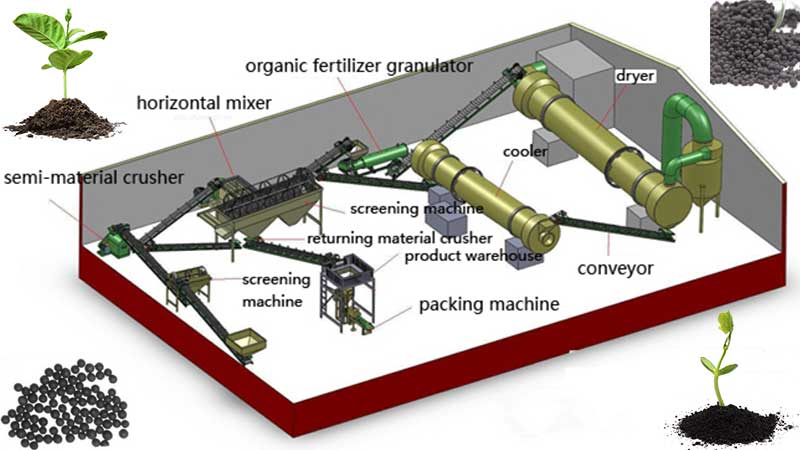
A fertilizer granulator is a machine that turns powdered fertilizer into small, round pellets. These machines are essential for making both organic and compound fertilizers. They turn powdered fertilizer into a more convenient and effective form for application.
Why Fertilizer Granulation Actually Matters
Let me share a quick story.
A few years back, I visited a fertilizer production facility in Iowa. The plant manager showed me two piles of fertilizer – one powdered, one granulated.
He grabbed a handful of each and let them fall through his fingers.
The powder? It created a dust cloud and stuck to everything.
The granules? They flowed smoothly, like tiny marbles.
That’s when it clicked for me. Granulation isn’t just about making fertilizer look pretty. It’s about making it WORK better.
In fact, studies show that granulated fertilizers have:
- 40% better distribution uniformity
- 75% less dust loss during application
- 3x longer storage life without caking
How Does a Fertilizer Granulator Machine Actually Work?
The basic process is surprisingly simple.
But first, let’s break down the main types of granulation:
Wet Granulation Process
This is the most common method. Here’s how it works:
- Mixing: Raw powder materials get mixed with water or liquid binders
- Agglomeration: The wet mixture tumbles in the granulator
- Shaping: Particles stick together and form small balls
- Drying: Excess moisture gets removed
- Screening: Granules get sorted by size
The moisture content here is critical. Too little? Nothing sticks together. Too much? You get giant mud balls.
Most operations aim for 20-40% moisture during granulation.
Dry Granulation Method
Some materials don’t play well with water. That’s where dry granulation shines.
Instead of using liquid, this method uses pure pressure to compress powder into granules.
Think of it like making a snowball – but with fertilizer powder instead of snow.
Types of Fertilizer Granulator Machines (And Which One You Actually Need)
Not all granulators are created equal.
Each type has its sweet spot. Let me break them down:
1. Disc Pelletizer (Pan Granulator)
Picture a giant, tilted frying pan that spins around.
That’s basically a disc pelletizer.
Best for: Small to medium operations (1-6 tons/hour)
Granule size: 2-5mm
Key advantage: You can see the entire process happening
The adjustable tilt angle is genius. Steeper angle = smaller granules. Shallow angle = bigger granules.
2. Rotary Drum Granulator
This is the workhorse of large-scale operations.
It’s essentially a huge rotating cylinder that tumbles materials around until they form granules.
Capacity: 3-20 tons/hour
Best for: NPK fertilizers and large batches
Key advantage: Enclosed design = better dust control
Pro tip: If you’re dealing with smelly organic fertilizers, the enclosed drum design is a game-changer.
3. Double Roller Extrusion Granulator
No water. No drying. Just pressure.
This machine squeezes powder between two rollers under massive pressure (50-200 MPa).
Best for: Water-sensitive materials
Energy savings: Up to 70% compared to wet granulation
Trade-off: Granules are flatter, not perfectly round
4. Stirring-Tooth Granulator
The new kid on the block.
High-speed rotating teeth create intense mixing action. It’s like a blender on steroids.
Granulation rate: 93-96% (that’s REALLY good)
Best for: Organic fertilizers and custom blends
The Real-World Benefits of Granulated Fertilizers
Here’s what actually happens when you switch from powder to granulated fertilizer:
1. Better Crop Yields
Uniform granules = uniform nutrient distribution = consistent crop growth.
One study found that farmers using granulated NPK fertilizer saw 15% higher yields compared to powder users.
2. Reduced Labor Costs
Ever tried spreading powder fertilizer by hand? It’s brutal.
Granulated fertilizer flows through mechanical spreaders like water. What used to take 8 hours now takes 2.
3. Environmental Impact
This is huge in 2025.
Granulated fertilizers reduce:
- Nutrient runoff by 35%
- Wind drift by 80%
- Water pollution risk by 40%
Bottom line? Better for your crops AND the environment.
Common Granulation Problems (And How to Fix Them)
Even the best equipment runs into issues. Here are the big ones:
Problem 1: Undersized Granules
Symptoms: Lots of dust, poor flowability
Usual culprit: Not enough binder or residence time
Quick fixes:
- Increase binder spray rate by 10-15%
- Slow down the rotation speed
- Check spray nozzles for clogs
Problem 2: Oversized Granules
Symptoms: Granules too big for spreaders, uneven application
Usual culprit: Too much moisture
Solutions:
- Reduce binder flow rate
- Increase equipment speed
- Add more recycled fines to absorb excess moisture
Problem 3: Weak Granules That Crumble
Symptoms: Granules break during handling, lots of dust in bags
Root cause: Poor binding or over-drying
Fixes:
- Switch to stronger binder (bentonite works great)
- Optimize drying temperature (not too hot!)
- Extend granulation time for better consolidation
ROI: Is a Fertilizer Granulator Machine Worth It?
Let’s talk numbers.
A decent granulator setup costs $50,000-500,000 depending on size.
Sounds expensive? Here’s the math:
- Granulated fertilizer sells for $15-25 MORE per ton
- Reduced handling losses save $5-10 per ton
- Lower transport costs save $3-7 per ton
Total value increase: $23-42 per ton
At 10 tons/day production, that’s $83,950-153,300 extra revenue per year.
Most operations see full ROI in 18-24 months.
Choosing the Right Fertilizer Granulator Machine in 2025
The fertilizer industry has changed dramatically.
Today’s buyers care about:
- Precision agriculture compatibility
- Environmental certifications
- Consistent granule size for GPS spreaders
Here’s my advice:
For startups: Start with a disc pelletizer. Lower investment, easier to learn.
For established operations: Rotary drum for volume, stirring-tooth for premium quality.
For specialty fertilizers: Double roller for dry formulations.
Future Trends in Fertilizer Granulation
The industry is evolving FAST.
Here’s what’s coming:
AI-Powered Process Control
Smart sensors monitor granule formation in real-time. The system adjusts automatically for perfect results.
Energy-Efficient Designs
New fluidized bed granulators use 40% less energy than traditional methods.
Biodegradable Coatings
Granules with smart coatings that release nutrients based on soil conditions.
Maintenance Tips That Actually Matter
Want your granulator to last 20 years instead of 5?
Do these things:
- Daily: Check spray nozzles and clear any clogs
- Weekly: Inspect wear liners and lubricate bearings
- Monthly: Measure wear parts and order replacements BEFORE they fail
- Yearly: Complete overhaul during slow season
Pro tip: Keep a maintenance log. It’ll save you thousands in prevented breakdowns.
The Bottom Line
What is fertilizer granulator machine? It’s the equipment that transforms dusty, hard-to-handle fertilizer powder into uniform, easy-to-apply granules that boost crop yields and reduce environmental impact.
Whether you’re running a small organic farm or a massive fertilizer plant, the right granulator can transform your operation. The technology has come a long way, and modern machines offer better efficiency, higher quality output, and faster ROI than ever before.
The key is matching the right machine to your specific needs – considering your materials, production volume, and quality requirements.
Remember: In the fertilizer business, consistency is king. And nothing delivers consistency like a well-chosen, properly operated granulator machine.


 English
  Spanish
  French
  Russian
  German
  Italian
  Turkish