
Here’s the deal:
If you’re in the fertilizer business (or thinking about jumping in), you’ve probably heard about NPK compound fertilizer production lines. But what is a NPK compound fertilizer production line exactly?

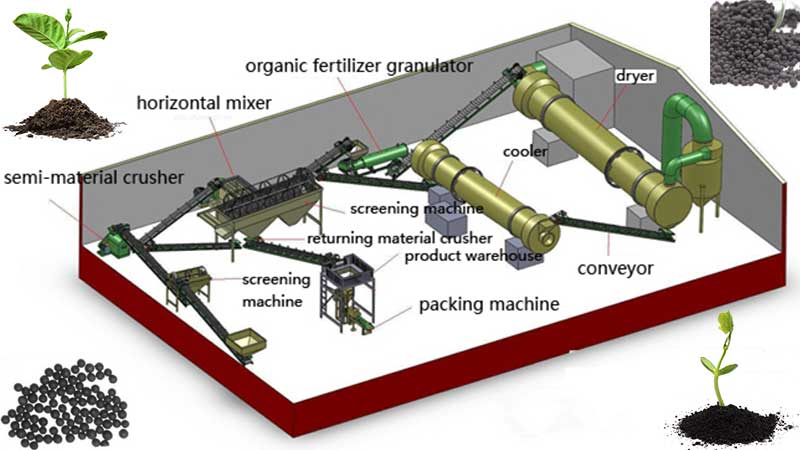
What is NPK Compound Fertilizer Production Line?
Simply put, it’s a system of specialized machinery that manufactures fertilizers containing the three essential plant nutrients: Nitrogen (N), Phosphorus (P), and Potassium (K).
Think of it as a factory assembly line specifically designed to create custom-blended fertilizers that farmers actually need.
And get this:
The global NPK fertilizer market is expected to hit $85 billion by 2025. That’s a lot of plant food.
In this guide, as a professional NPK fertilizer production line manufacturer, I’ll break down everything you need to know about NPK production lines. From the basic equipment to advanced production methods that actually work.
Let’s dive in.
Why NPK Fertilizer Production Lines Matter (More Than You Think)
Here’s something most people don’t realize:
Without NPK fertilizers, we’d need 50% more farmland to feed the world’s population.
That’s insane.
But here’s where it gets interesting:
Modern NPK production lines can create fertilizers with precise nutrient ratios like 15-15-15 or 20-10-10. This means farmers can pick the exact blend their soil needs.
No more guessing. No more waste.
In fact, I recently talked to a fertilizer manufacturer who switched from basic blending to a full granulation line. Their production efficiency jumped by 40% in just six months.
The bottom line?
NPK production lines aren’t just industrial equipment. They’re the backbone of modern agriculture.
The Two Main Types of NPK Fertilizer Production Lines
When it comes to NPK production, you’ve got two main options:
1. Granulating Production Lines
This is the heavy hitter of fertilizer production.
Granulating lines take raw powder materials and transform them into uniform granules. Think of it like making tiny fertilizer pellets that are easy to spread and won’t blow away in the wind.
Here’s what makes granulating lines special:
- Each granule contains all three nutrients (N-P-K)
- Better storage stability
- Reduced dust (your workers will thank you)
- Uniform application in the field
2. Blending Lines (BB Fertilizer Lines)
Blending lines are the simpler cousin.
Instead of creating granules from scratch, they mix pre-made fertilizer pellets in specific ratios. It’s like making trail mix – you’re combining ingredients that are already prepared.
The pros:
- Lower startup costs
- Simpler operation
- Quick formula changes
- Less energy consumption
The cons:
- Nutrients can separate during transport
- Limited to available raw materials
- Lower product value
The Complete NPK Fertilizer Production Process (Step-by-Step)
Let me walk you through exactly how these production lines work.
Step 1: Raw Material Preparation
First things first:
You need the right ingredients.
Common nitrogen sources include:
- Urea
- Ammonium sulfate
- Ammonium chloride
For phosphorus:
- Diammonium phosphate (DAP)
- Monoammonium phosphate (MAP)
- Rock phosphate
And potassium:
- Potassium chloride (MOP)
- Potassium sulfate (SOP)
Pro tip: The quality of your raw materials directly impacts your final product. Don’t cheap out here.
Step 2: Crushing and Grinding
Here’s where things get physical.
Large chunks of raw materials need to be crushed into fine powder. We’re talking particle sizes under 1mm for optimal mixing.
Most production lines use cage mills or chain crushers for this job. They’re workhorses that can handle everything from rock phosphate to hardened urea prills.
Step 3: Precise Batching
This is where the magic happens.
Modern batching systems use electronic scales and PLCs to measure each ingredient down to the kilogram. Getting this wrong means your 20-10-10 fertilizer might end up as 18-12-9.
Not good for business.
Step 4: Mixing
Once batched, materials hit the mixer.
Double-shaft mixers are the go-to choice. They provide thorough blending in about 3-5 minutes. Some plants add steam or water here to kickstart the granulation process.
Step 5: Granulation (The Heart of the Operation)
This is where powder becomes pellets.
You’ve got options:
Rotary Drum Granulators
- Most popular choice
- Handles high moisture content
- Produces round, uniform granules
- Capacity: 1-30 tons per hour
Disc Granulators
- Great for smaller operations
- Easy to observe and control
- Lower power consumption
- Capacity: 0.5-6 tons per hour
Double Roller Granulators
- Dry granulation (no drying needed!)
- Lower operating costs
- Produces irregular shapes
- Capacity: 1-20 tons per hour
Step 6: Drying and Cooling
Wet granules need love too.
Fresh granules contain 20-25% moisture. That’s way too wet for storage. Rotary dryers blast them with hot air (300°C inlet temperature) to bring moisture down to 1-2%.
Then comes cooling.
Hot granules are fragile and sticky. Rotary coolers bring them down to ambient temperature, locking in their structure.
Step 7: Screening
Not all granules are created equal.
Rotary screens separate the good from the bad:
- Perfect size (2-5mm): Move to coating
- Too small: Back to mixing
- Too big: To the crusher, then back to screening
This recycling system means almost zero waste. Smart, right?
Step 8: Coating (Optional but Valuable)
Want to level up your fertilizer game?
Add a coating.
Coatings can:
- Prevent caking
- Add micronutrients
- Create slow-release properties
- Reduce dust
- Make products prettier (yes, that matters)
Step 9: Packaging
The final stretch.
Automatic bagging machines fill 25kg or 50kg bags at rates up to 800 bags per hour. Some lines include robotic palletizers for fully automated packaging.
Essential Equipment for NPK Fertilizer Production
Let’s talk hardware.
Here’s what you absolutely need:
Core Equipment:
- Crusher (1-2 units)
- Batching system (3-6 hoppers)
- Mixer (1 unit)
- Granulator (1-2 units)
- Dryer (1 unit)
- Cooler (1 unit)
- Screening machine (1-2 units)
- Packaging system
Supporting Equipment:
- Belt conveyors
- Bucket elevators
- Dust collection systems
- Control panels
- Coating machine (optional)
Total investment? Anywhere from $100,000 for a basic line to $5 million for a fully automated system.
Production Capacity and Scaling
Here’s what’s possible:
Small Scale (1-5 tons/hour)
- Perfect for regional markets
- Investment: $100,000-500,000
- Staff needed: 5-10 people
- ROI: 18-24 months
Medium Scale (5-20 tons/hour)
- Serves multiple regions
- Investment: $500,000-2 million
- Staff needed: 15-25 people
- ROI: 24-36 months
Large Scale (20+ tons/hour)
- National/international markets
- Investment: $2-10 million
- Staff needed: 30-50 people
- ROI: 36-48 months
Advanced Features and Technology
Modern NPK lines are getting smarter.
Automation Upgrades:
- PLC control systems
- SCADA monitoring
- Automatic formula adjustment
- Real-time quality testing
- Predictive maintenance alerts
One manufacturer I know installed a full automation package in 2024. Result? 30% less labor costs and 99.5% formula accuracy.
That’s the future of fertilizer production.
Quality Control and Testing
Quality isn’t optional.
Here’s what top producers monitor:
Physical Properties:
- Granule size distribution
- Moisture content
- Bulk density
- Crushing strength
- Angle of repose
Chemical Properties:
- NPK content accuracy
- pH levels
- Heavy metal content
- Micronutrient levels
Testing Frequency:
- Raw materials: Every batch
- In-process: Every 2 hours
- Final product: Every 4 hours
Environmental and Safety Considerations
Let’s be real:
Fertilizer production can be messy.
But modern plants are cleaning up their act:
Dust Control:
- Enclosed conveyors
- Bag filters on all transfer points
- Wet scrubbers for granulator exhaust
- Regular housekeeping protocols
Emissions Management:
- Ammonia scrubbers
- Particulate filters
- Heat recovery systems
- Stack monitoring
Safety First:
- Explosion-proof equipment
- Gas detection systems
- Emergency showers
- Regular safety training
Common Challenges and Solutions
Every production line faces issues. Here are the big ones:
Problem: Granule quality inconsistency
Solution: Check mixer efficiency and moisture levels. Often it’s a simple calibration issue.
Problem: High product moisture
Solution: Increase dryer temperature or reduce feed rate. Don’t forget to check your exhaust system.
Problem: Dust everywhere
Solution: Install proper dust collection at transfer points. Your lungs (and equipment) will thank you.
Problem: Formula accuracy issues
Solution: Calibrate scales monthly. Replace worn batching components immediately.
Future Trends in NPK Fertilizer Production
The industry’s evolving fast.
What’s Coming:
- AI-powered quality control
- Biodegradable coating materials
- Carbon-neutral production methods
- Custom micronutrient integration
- IoT-enabled remote monitoring
Smart money’s betting on automation and sustainability. Plants that adapt will thrive.
Making the Investment Decision
Thinking about setting up an NPK line?
Consider these factors:
Market Analysis:
- Local fertilizer demand
- Competition landscape
- Raw material availability
- Transportation costs
- Regulatory requirements
Financial Planning:
- Initial investment
- Operating costs
- Expected revenue
- Break-even timeline
- Financing options
Technical Considerations:
- Available space
- Power supply
- Water access
- Environmental permits
- Skilled labor availability
The Bottom Line
NPK compound fertilizer production lines are complex systems, but they’re not rocket science.
With the right equipment, proper training, and attention to quality, these lines can be incredibly profitable.
The key is starting with clear goals and building from there.
Whether you choose granulation or blending, automation or manual control, the fundamentals remain the same: precise formulation, consistent quality, and efficient operation.
As we head into 2025, the demand for quality NPK fertilizers continues to grow. Smart producers who invest in modern production lines will be positioned to capture this expanding market.
So, what is npk compound fertilizer production line? It’s your gateway to feeding the world profitably.


 English
  Spanish
  French
  Russian
  German
  Italian
  Turkish