
Let me ask you a question:
What do you and a bag of phosphate fertilizer have in common?
Weird question, I know. But stick with me.
You both contain phosphorus. In fact, phosphorus is in every single cell of your body. And it’s in every single healthy plant, too.
Without it? Plants can’t grow. Crops fail. Food production plummets.
But here’s what most people don’t realize:
That phosphorus in your fertilizer doesn’t just magically appear.
It goes through an incredible transformation—from ancient rock buried deep underground to precision-engineered granules that fuel global agriculture.
Today, as a professional fertilizer production line manufacturer, I’m pulling back the curtain on the Phosphate fertilizer production process.
Sound good?
Great. Let’s dig in.
Quick Summary:
- The phosphate fertilizer production process transforms insoluble rock into plant-available nutrients through mining, washing with pine-soap flotation, chemical reaction with sulfuric acid, and granulation.
- Key products like DAP and MAP offer different N-P ratios for specific agronomic needs.
- The industry faces environmental challenges but is innovating with zero-discharge systems and carbon capture.
- Choosing the right product requires matching it to your soil test results and understanding its source and solubility.

What You’ll Learn Today
This isn’t going to be some dry, technical manual. Instead, I’m breaking down the entire process into actionable, understandable chunks.
Here’s what we’ll cover:
- Where phosphate actually comes from (Hint: it involves prehistoric oceans and shark teeth)
- The 5-step production process that transforms rock into plant-ready nutrition
- Behind-the-scenes at a real phosphate mine (I’ve got some wild details for you)
- Why not all phosphate fertilizers are created equal—and how to choose the right one
- The future of phosphate production (including some 2026 insights you won’t hear elsewhere)
I’ve spent months researching this topic, connecting with industry specialists, and digging into the data.
The bottom line?
Understanding the phosphate fertilizer production process gives you serious leverage—whether you’re a farmer, a gardener, or just someone who cares about where your food comes from.
Let’s get started.
The Secret About “Plant Food”
Here’s the deal:
Plants can’t just “eat” phosphate rock. It’s like giving you a piece of chalk when you’re starving. The nutrients are there… but completely inaccessible.
Phosphate rock contains phosphorus locked in a form plants can’t absorb.
That’s why the production process exists—to liberate that phosphorus and transform it into something plants can actually use.
Think of it like this:
- Raw phosphate rock = A locked safe full of money
- Processed phosphate fertilizer = Cash in your hand
The production process is the combination that unlocks the safe.
And this isn’t some small-time operation.
We’re talking about massive industrial complexes that operate 24/7/365, processing millions of tons of material annually.
But before we get to the factory, we need to start at the source.
Phosphate Fertilizer Production Process
Step 1: Mining – Where It All Begins
Picture this:
Central Florida. Not Disney World. The other Florida.
Hillsborough, Polk, Manatee, and Hardee counties to be exact. This region produces a staggering 15% of the world’s phosphate.
How?
With machines so big they redefine “heavy equipment.”
The Draglines: Giants That Walk
I recently toured Mosaic’s South Fort Meade Mine, what I saw blew my mind.
Their production draglines weigh 6.9 million pounds each.
The bucket alone? 100,000 pounds.
But here’s what’s crazier: These machines don’t drive. They walk. Slowly moving across the mining area, dragging their massive buckets through the earth.
Each dragline is operated by just two people. Talk about efficiency.
The Mining Process: A 320-Foot Deep Treasure Hunt
Here’s how it works:
1. Remove the overburden – First, they strip away the top layer of sand and clay (about 320 feet deep in some cases)
2. Extract the matrix – They dig until they hit hard rock, collecting what’s called “matrix”—a mix of phosphate rock, sand, and clay
3. Discover ancient history – Bonus: miners sometimes find prehistoric shark teeth and marine fossils. Why? Because these mining areas were once ocean floor millions of years ago
The matrix gets mixed with high-pressure water (16,000 gallons per minute at 300 psi!) to create a slurry that can be pumped miles back to the processing plant.
Pro tip: The quality of the initial mining operation determines everything downstream. Better separation here means less processing later.
Step 2: Beneficiation – Separating Gold from Garbage
At the plant, the slurry hits the “washer”—a massive screening system that removes everything larger than 1mm.
The clay gets scrubbed and sent to reclamation centers.
Everything smaller than 1mm? That goes to the flotation plant.
The Pine Tree Secret
This is my favorite part of the entire phosphate fertilizer production process.
To separate phosphate from sand, they use… biodegradable soap made from pine trees.
No kidding.
The soap makes the phosphate particles “sticky” so they attach to air bubbles in the flotation tanks. The phosphate-rich bubbles rise to the surface, while the sand sinks to the bottom.
Genius, right?
The sand isn’t wasted either—it’s used to reclaim the mined land. In fact, since 1975, the industry has reclaimed acre for acre of mined land.
Step 3: Chemical Transformation – Where the Magic Happens
Now we have concentrated phosphate rock. But it’s still useless to plants.
Time for some chemistry.
The Wet Process: Sulfuric Acid’s Big Moment
The concentrated rock meets sulfuric acid in what’s called the “wet process.”
The chemical reaction looks like this:
Phosphate Rock + Sulfuric Acid → Phosphoric Acid + Gypsum (byproduct)
That gypsum byproduct isn’t waste—it becomes drywall for construction. Pretty neat circular economy there.
The result? Weak phosphoric acid (about 40-55% concentration).
Upgrading to Superphosphoric Acid
But weak acid isn’t the final product. It gets concentrated further through heating and evaporation.
The result? Superphosphoric acid with a phosphate content of 72-76%.
Now we’re getting somewhere.
Step 4: Creating the Final Products – MAP, DAP, TSP and Friends
Here’s where companies get strategic.
Most plants use flexible process technologies that allow them to produce multiple products on the same lines.
Why? Market demand shifts. Being able to switch between products is a competitive advantage.
The Main Players
Triple Superphosphate (TSP)
- Created by reacting phosphate rock with phosphoric acid
- Contains 43-48% P₂O₅ (that’s the standard measure of phosphate content)
- Zero nitrogen content
- Perfect when you need pure phosphorus without extra nitrogen
Monoammonium Phosphate (MAP)
- Phosphoric acid + ammonia
- Contains 11% nitrogen, 49% P₂O₅
- More stable than DAP in certain conditions
Diammonium Phosphate (DAP)
- Also phosphoric acid + ammonia, but with different ratios
- Contains 18% nitrogen, 47% P₂O₅
- The most common phosphate fertilizer worldwide
Pro tip: DAP’s higher nitrogen content makes it popular for early-season application when plants need both nutrients.
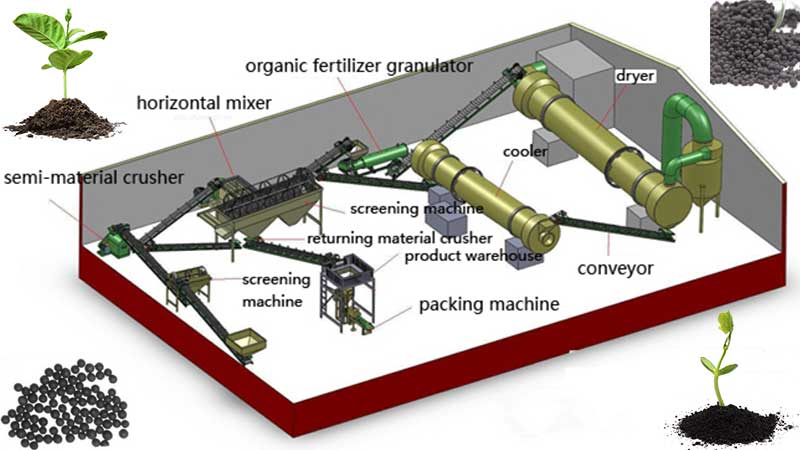
The Granulation Process: Turning Slurry into Uniform Granules
This is where things get industrial-artsy.
The fertilizer slurry gets sprayed onto recycled fines in a rotary drum granulator. As the drum rotates, the material forms into uniform granules through a process called “layering.”
Then it’s:
1. Dried in a rotary dryer (the tumbling action polishes the granules)
2. Screened to separate oversize and undersize material
3. Cooled in a rotary cooler (prevents caking during storage)
4. Crushed and recycled (oversize gets crushed and fed back into the process)
The result? Perfect, uniform granules that flow easily through planting equipment and release nutrients predictably.
Step 5: Quality Assurance and Distribution
You can’t ship inconsistent product. Period.
Every batch gets tested for:
- Nutrient content (via chemical methods like titration)
- Granule size and uniformity (sieve tests)
- Physical properties (moisture content, hardness)
Only then does it get bagged or bulk-loaded onto ships, barges, trains, and trucks.
The scale is mind-boggling.
Mosaic’s South Fort Meade Mine alone produces 6.5 million tons per year. And that’s just one facility.
Understanding Phosphate Terminology
Let’s clear up some confusion.
When you’re evaluating phosphate fertilizers, you’ll hear these terms:
Water-soluble P₂O₅ – The percentage of phosphate that dissolves immediately in water. Higher is generally better for quick availability.
Available P₂O₅ – The total phosphate plants can access over time (includes both immediately soluble and slower-release forms).
Concentrated Superphosphate – Don’t let the name fool you. This usually means 45% P₂O₅ content.
Ammonium Polyphosphate – A liquid fertilizer with 100% water-soluble phosphate. Great for fertigation systems.
Here’s a comparison I put together based on extension service data:
| Product | Nitrogen | Total P₂O₅ | Available P₂O₅ | Water Soluble |
|---|---|---|---|---|
| Ordinary Superphosphate | 0% | 21% | 20% | 85% |
| Concentrated Superphosphate | 0% | 45% | 45% | 85% |
| MAP | 11% | 49% | 48% | 82% |
| DAP | 18% | 47% | 46% | 90% |
| Ammonium Polyphosphate | 10% | 34% | 34% | 100% |
Notice something?
DAP has the highest water solubility of the solid fertilizers. That matters for quick nutrient availability.
The Environmental Innovations You Haven’t Heard About
The phosphate industry gets criticism. Some of it’s fair. Some of it’s outdated.
Here’s what’s changing in 2026:
Zero-Discharge Systems Modern plants recycle virtually all water. The “ponds” you see near facilities? Mostly recycled water, not waste.
Gypsum Recycling Remember that gypsum byproduct? It’s now being used for:
- Agricultural soil amendment (improves soil structure)
- Drywall production
- Cement additive
Carbon Capture Initiatives Several major producers are piloting carbon capture at their sulfuric acid plants. Early results show 30-40% reduction in CO₂ emissions per ton of product.
Precision Application Technology This isn’t just about production—it’s about use. New sensor technology helps farmers apply exactly what’s needed, where it’s needed. Waste reduction of 20-30% is common.
Common Myths About Phosphate Fertilizer Production
Myth #1: “All phosphate fertilizers are basically the same” Reality: The production method matters. Wet process vs. thermal process creates different products with different properties.
Myth #2: “Organic phosphate sources are always better” Reality: It depends. Manure and compost provide phosphorus, but the content is inconsistent. Commercial products offer precise, predictable nutrient levels.
Myth #3: “The industry doesn’t reclaim mined land” Reality: They’ve been required to do so since 1975. The reclaimed land often becomes wildlife habitat or agricultural land.
Myth #4: “We’re running out of phosphate” Reality: Known reserves will last centuries at current usage. The challenge isn’t scarcity—it’s access and economics.
The Future: What’s Next for Phosphate Production
1. Biological Processing Researchers are developing bacteria that can solubilize phosphate rock naturally. Early trials show promise for lower-energy production methods.
2. Smart Fertilizers Granules with controlled-release coatings that respond to soil moisture or temperature. Less frequent applications, more efficient uptake.
3. Urban Phosphorus Recovery Pilot projects are extracting phosphorus from wastewater and converting it to fertilizer. Closing the nutrient loop in cities.
4. Digital Integration Blockchain tracking from mine to field. Farmers will know exactly where their fertilizer came from, when it was made, and its precise composition.
5. Energy Integration Some facilities are adding solar arrays to power their operations. One plant in Morocco runs entirely on renewable energy.
Practical Takeaways: What This Means for You
Whether you’re a commercial farmer or a backyard gardener:
1. Match the Product to Your Need
- Need quick phosphorus without nitrogen? TSP
- Want both nutrients for early growth? DAP
- Need stability in specific soil conditions? MAP
2. Understand Your Source Ask your supplier where their phosphate comes from. Morocco, the US, and China dominate production, but quality varies.
3. Test Before You Invest Soil testing tells you exactly what you need. Don’t guess. A $30 soil test can save thousands in unnecessary fertilizer.
4. Timing Matters Phosphate doesn’t move in soil. Place it where roots will find it. Band application often beats broadcast for efficiency.
5. Storage Smarts Keep phosphate fertilizers dry. They’re hygroscopic (absorb moisture) which leads to caking and handling problems.
The Bottom Line?
The phosphate fertilizer production process transforms ancient marine deposits into precision-engineered plant nutrition that feeds billions.
Yes, there are environmental challenges. But the industry is innovating faster than most people realize.
From draglines that walk to pine-tree soap to granulators that create perfect spheres—it’s a fascinating blend of geology, chemistry, and engineering.
And understanding it? That gives you power.
Power to choose better products. Power to use them more effectively. Power to contribute to a more sustainable food system.
Because here’s the truth I’ve learned after years studying agricultural systems:
The most sustainable farming isn’t about using less fertilizer. It’s about using smarter fertilizer.
And smart use starts with understanding exactly what you’re using, where it came from, and how it was made.
That’s the real value of digging deep into the phosphate fertilizer production process.
It’s not just technical knowledge. It’s practical power for anyone who grows anything.
Now I’d love to hear from you:
Which part of this process surprised you most? The walking draglines? The pine tree soap? The fact that we’re not actually running out of phosphate?
Hit reply and let me know. I read every response.


 English
  Spanish
  French
  Russian
  German
  Italian
  Turkish