
Quick summary: Choose organic for lower entry costs ($30K–$500K) or NPK for larger but costlier operations ($1M+). Prioritize market validation, a site near raw materials, correct equipment sizing, and permits started 3–6 months early. Lock supply contracts with multiple suppliers, implement strict quality control, and plan for seasonality and inventory buffers. Expect 6–12 months from planning to production and aim for profitability in 18–24 months.
Want to know how to set up a fertilizer plant? You’re in the right place.
Over the last 5 years, as a professional fertilizer production line manufacturer, I’ve helped dozens of entrepreneurs launch successful fertilizer production facilities. From small organic operations to massive NPK plants.
And today, I’m going to show you the exact process.
The same process that helped a client in India build a 200,000-ton compound fertilizer facility. And another in Brazil start with just $30,000 and scale to $2M in annual revenue.
Let’s dive right in.
Why Start a Fertilizer Plant in 2026?
Here’s the deal:
The global fertilizer market is exploding. We’re talking $230 billion by 2028.
Why?
Simple. The world needs to feed 9.7 billion people by 2050. And that means farmers need more fertilizer. A LOT more.
But here’s what’s really interesting:
Small and medium-sized plants are crushing it right now. Especially in developing markets.
(In fact, one of my clients in Kenya started with a 50,000-ton facility and now supplies half the country.)
How to Set Up a Fertilizer Plant?
Step 1: Define Your Fertilizer Type and Target Market
First things first:
What type of fertilizer will you produce?
You’ve got two main options:
Organic Fertilizers:
- Made from manure, crop waste, compost
- Lower startup costs ($30K-$500K)
- Growing demand (15% yearly)
- Simpler production process
Chemical Fertilizers (NPK):
- Nitrogen, phosphorus, potassium compounds
- Higher investment ($1M-$50M+)
- Stable demand
- Complex chemistry required
Pro Tip: If you’re just starting out, I recommend organic. The barrier to entry is way lower. And the market is red hot.
Market Research That Actually Matters
Don’t just Google “fertilizer demand.”
Do THIS instead:
- Talk to local farmers (at least 20-30)
- Visit agricultural supply stores
- Check import data for your region
- Analyze competitor pricing
I had a client skip this step. Built a $2M urea plant. Then discovered farmers in his area only used organic fertilizer.
Ouch.
Step 2: Location Is Everything (Seriously)
Your plant location can make or break your business.
Here’s what to look for:
Proximity to Raw Materials
- Within 50km of suppliers = 30% lower transport costs
- Near farms for manure access
- Close to chemical suppliers (for NPK)
Infrastructure Requirements
- Reliable electricity (trust me on this one)
- Water access (lots of it)
- Good roads for trucks
Zoning and Distance
- Industrial zoning required
- At least 500m from residential areas
- Room for expansion
One of my clients in Vietnam saved $100K/year just by moving his plant 20km closer to phosphate mines.
Location matters. Big time.
Step 3: Equipment Selection (Don’t Overspend)
This is where most people mess up.
They either:
- Buy cheap equipment that breaks constantly
- Overspend on capacity they don’t need
Here’s the equipment you actually need:
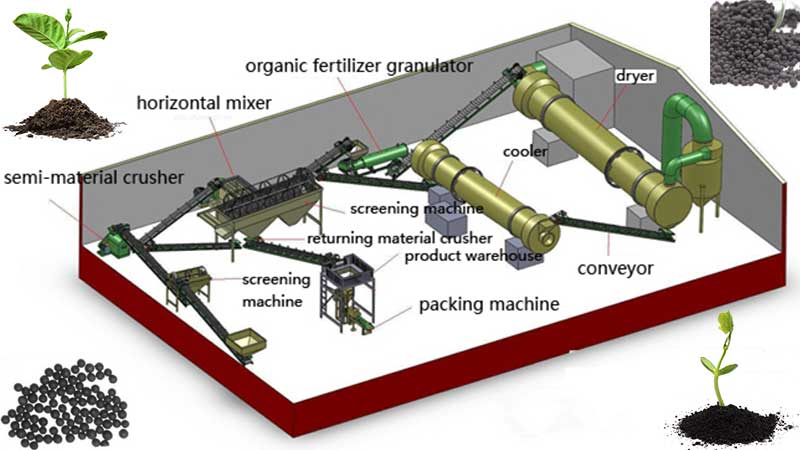
For Organic Fertilizer Plants:
Essential Equipment:
- Compost turner ($8,000-$15,000)
- Crusher ($3,000-$6,000)
- Mixer ($2,000-$4,000)
- Screener ($1,000-$2,000)
- Packaging machine ($3,000-$5,000)
Nice to Have:
- Granulator ($5,000-$9,000)
- Dryer ($6,000-$12,000)
- Coating machine ($4,000-$8,000)
Total investment: $22,000-$42,000 for basic setup
For Chemical Fertilizer Plants:
This gets expensive. Fast.
Core Equipment:
- Rotary drum granulator ($50,000-$200,000)
- Rotary dryer ($40,000-$150,000)
- Rotary cooler ($30,000-$100,000)
- Coating machine ($20,000-$80,000)
- Screening system ($15,000-$50,000)
Plus reactors, compressors, and specialized equipment depending on your process.
Total investment: $500,000-$5,000,000+
(See why I recommend starting with organic?)
Step 4: The Production Process Blueprint
Let me break down the actual production process.
Organic Fertilizer Production:
- Raw Material Collection
- Gather manure, crop waste, etc.
- Test for contaminants (critical!)
- Store properly to avoid rain damage
- Fermentation (20-30 days)
- Mix materials to 55-60% moisture
- Use compost turner every 2-3 days
- Monitor temperature (55-65°C kills pathogens)
- Processing
- Crush fermented material
- Mix with additives if needed
- Screen to remove oversized particles
- Drying and Packaging
- Reduce moisture to 15-20%
- Package in 25kg or 50kg bags
- Label with nutrient content
Chemical Fertilizer Production:
Way more complex. Here’s the NPK process:
- Raw Material Preparation
- Measure exact ratios (this is chemistry, folks)
- Crush to uniform size
- Pre-mix if needed
- Granulation
- Add binding solution
- Form granules in rotary drum
- Control particle size (2-4mm ideal)
- Drying and Cooling
- Dry to <2% moisture
- Cool to near ambient temperature
- Critical for storage stability
- Coating and Packaging
- Apply anti-caking agent
- Package immediately
- Store in dry conditions
Step 5: Licensing and Compliance (The Boring But Critical Stuff)
Nobody likes paperwork.
But skip this step and you’ll get shut down. Fast.
Essential Permits:
- Business License ($100-$500)
- Manufacturing License ($500-$5,000)
- Environmental Permits ($1,000-$10,000)
- Product Registration ($200-$2,000 per product)
Compliance Standards to Meet:
- China: NY525-2021 standards
- USA: EPA regulations, state fertilizer laws
- EU: EC 834/2007 for organic
- India: FCO 1985 requirements
Pro Tip: Start the permit process 3-6 months before your planned launch. I’ve seen delays kill too many good projects.
Step 6: Financial Planning That Actually Works
Let’s talk money.
Here’s a realistic breakdown for different scales:
Small Organic Plant (50,000 tons/year):
- Equipment: $50,000-$100,000
- Facility: $20,000-$50,000
- Working capital: $30,000-$50,000
- Total: $100,000-$200,000
Medium NPK Plant (100,000 tons/year):
- Equipment: $1,500,000-$2,500,000
- Facility: $500,000-$1,000,000
- Working capital: $500,000-$1,000,000
- Total: $2,500,000-$4,500,000
Operating Costs to Consider:
- Raw materials (40-60% of revenue)
- Labor (10-15% of revenue)
- Utilities (5-10% of revenue)
- Maintenance (3-5% of revenue)
Step 7: Staffing Your Plant (Quality Over Quantity)
You don’t need an army.
But you DO need the right people.
Essential Positions:
For Small Plants (5-10 employees):
- Plant manager
- Production operators (2-3)
- Quality control technician
- Maintenance worker
- Sales/admin (1-2)
For Large Plants (20-50 employees):
- Add engineers, chemists, more operators
Average Salaries (USA, 2026):
- Plant Operator: $25-$32/hour
- Equipment Operator: $28-$35/hour
- Production Worker: $22-$30/hour
- Plant Manager: $80,000-$120,000/year
Step 8: Quality Control Systems
This separates successful plants from failures.
Test Everything:
- Raw materials (before purchase)
- During production (every batch)
- Final product (before shipping)
Key Parameters to Monitor:
- Nutrient content (NPK ratios)
- Moisture levels
- Particle size
- Heavy metals
- Pathogens (for organic)
Invest in basic testing equipment ($5,000-$15,000). Or outsource to labs initially.
Common Mistakes That Kill Fertilizer Plants
I’ve seen these mistakes dozens of times:
1. Overestimating Local Demand
One client built for 200,000 tons/year. Local demand? 50,000 tons.
Result: Bankruptcy in 18 months.
2. Cheaping Out on Equipment
Saving $20K on a crusher seems smart. Until it breaks every week.
Lost production costs way more than quality equipment.
3. Ignoring Seasonality
Fertilizer demand isn’t constant. Plan for 3-4 months of slow sales.
4. Poor Raw Material Contracts
Lock in suppliers early. Price spikes can destroy your margins.
The Supply Chain Secret
Here’s something most guides won’t tell you:
Your supply chain is EVERYTHING.
For Raw Materials:
- Contract with 3+ suppliers minimum
- Never rely on spot market pricing
- Build 30-60 days inventory buffer
For Distribution:
- Partner with agricultural cooperatives
- Build relationships with large farms
- Consider dealer networks
I had a client lose $500K because his single urea supplier raised prices 40% overnight.
Don’t be that guy.
Automation and Technology in 2026
The game has changed.
Modern plants use:
- PLC control systems (reduce labor 50%)
- Automated packaging (double throughput)
- IoT sensors (predict maintenance)
- AI quality control (catch defects early)
Yes, it costs more upfront. But ROI is typically 18-24 months.
Marketing Your Fertilizer (It’s Not Just About Price)
Farmers are loyal. But only if you earn it.
What Actually Works:
- Field demonstrations (seeing is believing)
- Free soil testing (builds trust)
- Agronomist support (huge differentiator)
- Flexible payment terms (critical for farmers)
One client grew sales 300% in one year. How? Free soil testing and customized fertilizer recommendations.
Simple. But effective.
Scaling Your Fertilizer Plant
Start small. Scale smart.
Year 1-2: Foundation
- Perfect your process
- Build customer base
- Generate cash flow
Year 3-4: Expansion
- Add production lines
- Expand product range
- Enter new markets
Year 5+: Domination
- Multiple facilities
- Vertical integration
- Export opportunities
Environmental Considerations
Ignore this at your peril.
Modern fertilizer plants must:
- Control emissions (dust, gases)
- Manage waste water
- Reduce energy consumption
- Implement recycling
Good news? Environmental compliance is now a selling point.
“Eco-friendly” fertilizer commands 10-20% premium prices.
The Bottom Line
Setting up a fertilizer plant isn’t rocket science.
But it does require:
- Smart planning
- Right equipment
- Proper licensing
- Quality focus
- Patient capital
Follow this guide and you’ll avoid 90% of common mistakes.
The global food crisis isn’t going away. Neither is fertilizer demand.
Now’s the time to act.
Start with market research. Pick your fertilizer type. Find the right location. And build step by step.
Remember: every massive fertilizer company started with one plant.
Why not yours?
The complete process of how to set up a fertilizer plant takes 6-12 months from planning to production. But with the right approach, you’ll be profitable within 18-24 months.
That’s how you set up a fertilizer plant that actually succeeds.


 English
  Spanish
  French
  Russian
  German
  Italian
  Turkish