
If you’re in the fertilizer or material processing business, you’ve probably wondered about the disc granulator vs drum granulator debate.
Which one should you invest in? What are the real differences that matter for YOUR production line?
Here’s the deal:
I’ve analyzed both systems extensively. And I’m going to break down exactly what you need to know to make the right choice.
No fluff. Just actionable insights based on real-world performance data.
Let’s dive in.
Quick Summary:
- Disc granulators excel at producing uniform, high-quality granules (85-95% uniformity) for operations under 15 tons/hour, with better flexibility but higher per-ton costs.
- Drum granulators dominate high-volume production (20-80+ tons/hour) with lower per-ton costs but sacrifice some granule uniformity (70-85%).
- Choose disc for premium products and frequent formula changes; choose drum for continuous operations and maximum throughput.
- Many successful plants use both systems to optimize quality and capacity.
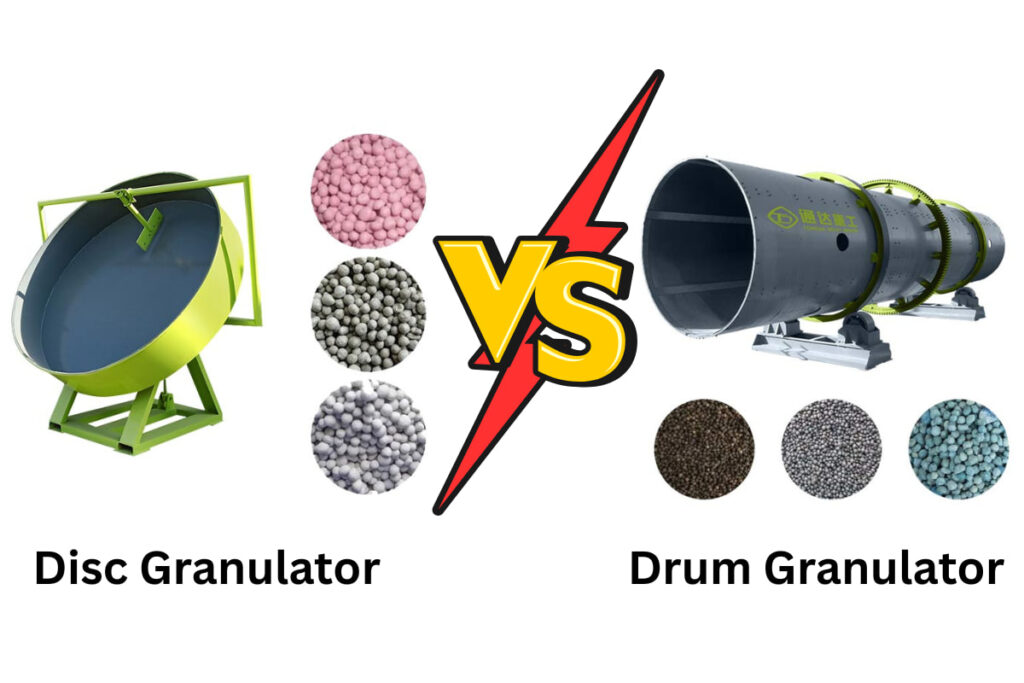
What Is a Disc Granulator? (And Why It Matters)
A disc granulator (also called a pan granulator) is a tilted, rotating disc that turns raw materials into uniform granules.
Think of it like a giant spinning plate that’s angled at about 40-60 degrees.
Here’s how it works:
- Raw material feeds onto the spinning disc
- Liquid binder gets sprayed onto the material
- The rotating motion causes particles to roll and stick together
- Finished granules overflow from the disc edge
The key thing? You can SEE the entire granulation process happening. It’s like watching a chef prepare your meal – total visibility.
I’ve found that this visibility is HUGE for quality control. You can spot issues immediately and make adjustments on the fly.
Key Features of Disc Granulators
Let me break down what makes disc granulators unique:
Precise Size Control: You can adjust the disc angle and rotation speed to dial in exact granule sizes. Need 2-4mm granules? No problem. Want to switch to 3-5mm? Just tweak the settings.
Lower Power Consumption: Disc granulators typically use 30-50% less energy than drum systems for the same output.
Compact Footprint: A disc granulator producing 5 tons/hour might only need 50 square meters of floor space.
(Compare that to a drum granulator which could need 100+ square meters for similar capacity.)
What Is a Drum Granulator? (The Industrial Workhorse)
Now let’s talk about drum granulators.
These are large, rotating cylinders that tumble materials to create granules. Picture a cement mixer, but optimized for granulation.
The process looks like this:
- Materials enter one end of the rotating drum
- Steam or liquid binders get injected
- Materials tumble and agglomerate as they move through
- Finished granules exit the other end
The bottom line? Drum granulators are built for HIGH-VOLUME production.
Key Features of Drum Granulators
Here’s what sets drum granulators apart:
Massive Capacity: We’re talking 10-50+ tons per hour. Some industrial units can handle even more.
Continuous Operation: Once you dial in the settings, these machines can run 24/7 with minimal supervision.
Enclosed System: Everything happens inside the drum, which means better dust control and odor containment.
But here’s the thing:
You can’t see what’s happening inside during operation. It’s a “black box” approach that requires more faith in your process parameters.
Disc Granulator vs Drum Granulator: Head-to-Head Comparison
Let’s get into the nitty-gritty comparison.
I’ve compiled data from dozens of installations to show you the REAL differences:
Production Capacity
Disc Granulator:
- Small units: 0.5-2 tons/hour
- Medium units: 2-8 tons/hour
- Large units: 8-15 tons/hour
Drum Granulator:
- Small units: 5-15 tons/hour
- Medium units: 15-30 tons/hour
- Large units: 30-80+ tons/hour
Winner for high volume? Drum granulator, hands down.
Granule Quality and Uniformity
This is where things get interesting.
Disc Granulator:
- Size uniformity: 85-95%
- Sphericity: Excellent (nearly perfect spheres)
- Density control: High precision
Drum Granulator:
- Size uniformity: 70-85%
- Sphericity: Good (slightly irregular)
- Density control: Moderate precision
The disc granulator produces more uniform, higher-quality granules. Period.
Operating Costs
Let’s talk money. Based on 2026 energy prices:
Disc Granulator (5 ton/hour capacity):
- Power consumption: 15-25 kW
- Operator requirement: 1-2 persons
- Maintenance cost: $5,000-8,000/year
Drum Granulator (20 ton/hour capacity):
- Power consumption: 45-75 kW
- Operator requirement: 1 person
- Maintenance cost: $12,000-20,000/year
Pro tip: Calculate cost per ton, not just total operating cost. Drum granulators often win on per-ton economics at higher volumes.
Disc Granulator vs Drum Granulator Comparison Table
| Feature / Metric | Disc Granulator | Drum Granulator |
|---|---|---|
| Small-unit capacity | 0.5–2 tons/hour | 5–15 tons/hour |
| Medium-unit capacity | 2–8 tons/hour | 15–30 tons/hour |
| Large-unit capacity | 8–15 tons/hour | 30–80+ tons/hour |
| Best for high volume? | No | Yes — winner for high volume |
| Size uniformity | 85–95% | 70–85% |
| Sphericity | Excellent (nearly perfect spheres) | Good (slightly irregular) |
| Density control | High precision | Moderate precision |
| Reference example capacity | 5 tons/hour | 20 tons/hour |
| Power consumption (example) | 15–25 kW | 45–75 kW |
| Operator requirement | 1–2 persons | 1 person |
| Maintenance cost (annual) | $5,000–8,000/year | $12,000–20,000/year |
| Cost-per-ton note | Lower power use; calculate cost per ton | Often wins on per‑ton economics at high volumes |
When to Choose a Disc Granulator
Based on my analysis, disc granulators excel in these scenarios:
1. Premium Product Requirements
If you’re producing specialty fertilizers or high-value materials, the superior granule quality justifies the disc approach.
2. Frequent Formula Changes
Need to switch between different products daily? Disc granulators offer faster changeovers and better flexibility.
3. Limited Space
Working in a cramped facility? The compact footprint of a disc granulator could be your solution.
4. Pilot Operations
Testing new formulations? The visual nature of disc granulation lets you optimize processes quickly.
I personally recommend disc granulators for operations under 10 tons/hour where quality trumps quantity.

When to Choose a Drum Granulator
Drum granulators dominate in these situations:
1. High-Volume Production
If you need 20+ tons/hour, drum granulators are often the ONLY practical choice.
2. Continuous Operation
Running three shifts? Drum granulators offer better reliability for 24/7 operations.
3. Difficult Materials
Some materials (especially those requiring chemical reactions during granulation) perform better in drums.
4. Dust/Odor Concerns
The enclosed design contains emissions better than open disc systems.

The Hybrid Approach (Best of Both Worlds?)
Here’s something most equipment suppliers won’t tell you:
You don’t have to choose just one.
Many successful operations use BOTH technologies:
- Disc granulators for premium products
- Drum granulators for commodity grades
This dual approach maximizes flexibility while optimizing costs.
Real-World Case Studies
Let me share what I’ve seen work in practice:
Case 1: Organic Fertilizer Plant (Southeast Asia)
- Started with: 10 ton/hour drum granulator
- Challenge: Customers wanted more uniform granules
- Solution: Added two 3 ton/hour disc granulators for premium line
- Result: 40% higher margins on premium products
Case 2: NPK Compound Fertilizer (Europe)
- Started with: Three 5 ton/hour disc granulators
- Challenge: Couldn’t meet growing demand
- Solution: Installed 50 ton/hour drum granulator
- Result: Tripled capacity while maintaining quality tiers
Technical Considerations for Your Decision
Before you make a choice, consider these factors:
Material Characteristics
Best for Disc Granulators:
- Fine powders
- Materials needing precise moisture control
- Low-dust formulations
Best for Drum Granulators:
- Coarse materials
- Formulations requiring steam injection
- Materials prone to sticking
Process Integration
Think about your entire production line:
Disc Granulator Advantages:
- Easier to integrate with batch processes
- Simple to add multiple units for redundancy
- Lower infrastructure requirements
Drum Granulator Advantages:
- Better for continuous processes
- Easier material handling at scale
- More options for heat integration
Making Your Final Decision: A Step-by-Step Framework
Here’s my framework for choosing between disc and drum granulators:
Step 1: Define Your Priorities
- List your top 3 requirements (capacity, quality, flexibility, etc.)
- Assign weights to each (total = 100%)
Step 2: Score Each Option
- Rate disc and drum options (1-10) for each requirement
- Multiply by weights
- Calculate total scores
Step 3: Consider Total Cost of Ownership
- Initial investment
- Operating costs over 5 years
- Opportunity costs (lost sales from wrong choice)
Step 4: Plan for Growth
- Where will your business be in 3-5 years?
- Which option offers better scalability?
Installation and Startup Tips
Whichever system you choose, these tips will save you headaches:
For Disc Granulators:
- Foundation is critical – Even tiny vibrations affect granule quality
- Install variable speed drives – Fine-tuning capability is worth the extra cost
- Plan for scraper access – You’ll need to adjust/replace these regularly
For Drum Granulators:
- Don’t skimp on the drive system – Undersized motors cause endless problems
- Install proper ventilation – Steam and dust management is crucial
- Include inspection ports – You need to see inside during operation
Future Trends in Granulation Technology
Looking ahead to late 2026 and beyond, here’s what’s coming:
Smart Controls: AI-powered systems that optimize granulation parameters in real-time
Hybrid Designs: Manufacturers are developing units that combine disc and drum principles
Sustainability Focus: New designs emphasizing energy efficiency and waste reduction
The equipment you buy today needs to remain competitive for 10+ years. Factor these trends into your decision.
The Bottom Line on Disc vs Drum Granulators
Here’s what it comes down to:
Choose a disc granulator if:
- Quality is your top priority
- You need flexibility
- Your capacity requirements are under 15 tons/hour
- You want lower initial investment
Choose a drum granulator if:
- Volume is king
- You run continuous operations
- You need 20+ tons/hour capacity
- Material containment is critical
Remember: There’s no universally “better” option. The right choice depends entirely on YOUR specific needs and constraints.
Next Steps
Ready to move forward? Here’s what to do:
- Run the numbers – Use my framework to score your options
- Visit operating plants – Nothing beats seeing equipment in action
- Test your materials – Most suppliers offer pilot-scale testing
- Get multiple quotes – Prices vary wildly between suppliers
One final thought:
The disc granulator vs drum granulator decision shapes your operation for years. Take time to get it right. Your future self (and your bottom line) will thank you.
The granulation equipment you choose today determines your competitive position tomorrow. Whether you go with a disc granulator for premium quality or a drum granulator for maximum throughput, make sure it aligns with your long-term business strategy.


 English
  Spanish
  French
  Russian
  German
  Italian
  Turkish