
Ever wondered how that bag of fertilizer in your garden shed gets made? It’s not as simple as mixing dirt and chemicals. The fertilizer manufacturing process is a fascinating blend of science, engineering, and raw materials straight from nature.
In this guide, as a professional fertilizer production line manufacturer, I’ll break the fertilizer manufacturing process down step by step. We’ll cover everything from nitrogen production to blending NPK compounds. Sound good? Let’s dive in.
How Farmers Rely on Fertilizers
First off, why care about the fertilizer manufacturing process? Well, fertilizers power global agriculture. Without them, crop yields would plummet by up to 50%, according to the FAO. That’s a big deal for food security in 2025.
Think about it: Farmers and gardeners are always hunting for reliable info. But here’s the deal – understanding the process helps you choose better products or even spot trends in sustainable farming.
I’ve dug into industry reports and chatted with experts. In my experience, knowing the basics makes all the difference.
Fertilizer Manufacturing Process
Key Raw Materials in Fertilizer Production
The fertilizer manufacturing process starts with sourcing raw materials. These aren’t fancy – mostly air, natural gas, and mined ores.
Nitrogen comes from the air (78% of our atmosphere). Hydrogen? Pulled from natural gas. Phosphorus is mined as phosphate rock from places like Morocco or Florida. Potassium? From potash deposits in Canada or Russia.
Pro tip: Always check for sustainable sourcing. Over-mining can lead to environmental headaches.
But here’s the thing: These materials get transformed through chemical reactions. Let’s break it down by nutrient type.
Nitrogen Fertilizer Manufacturing: The Haber-Bosch Breakdown
Nitrogen fertilizers are the heavy hitters. They make up about 60% of global fertilizer use.
The core process? Haber-Bosch. Here’s how it works:
- Extract nitrogen from air and hydrogen from natural gas.
- Mix them under high pressure (200-400 atmospheres) and temperature (400-650°C) with an iron catalyst.
- Boom – you get ammonia (NH3).
From there, ammonia turns into urea by reacting with CO2. Or ammonium nitrate via oxidation to nitric acid.
In my view, this step is energy-intensive. It gulps down 1-2% of global energy. But innovations like green hydrogen are changing that.
For example, a plant in Norway uses electrolysis for hydrogen – cutting emissions by 90%.
Phosphorus Fertilizer: From Rock to Crop Booster
Phosphorus keeps plants strong. The manufacturing kicks off with mining phosphate rock.
Step 1: Crush and beneficiate the rock to remove impurities.
Step 2: Treat with sulfuric acid in the “wet process” to make phosphoric acid (H3PO4).
Step 3: React with ammonia for MAP or DAP fertilizers.
Challenges? The acid is corrosive, so equipment needs top-notch materials.
Data point: Global phosphorus reserves might last 300-400 years, per USGS. But recycling efforts are ramping up.
I’ve seen farms switch to slow-release phosphorus to cut runoff. Smart move for eco-friendly ops.
Potassium Fertilizer: Mining and Refining Potash
Potassium helps with water regulation in plants. It’s sourced from potash salts.
Process overview:
- Mine underground deposits.
- Use hot water to dissolve and crystallize potassium chloride (KCl), aka Muriate of Potash.
- For sulfate forms, add sulfuric acid.
This one’s straightforward but dusty. Evaporation ponds in places like Utah handle massive volumes.
Bottom line? Potassium boosts drought resistance – crucial as climates shift in 2025.
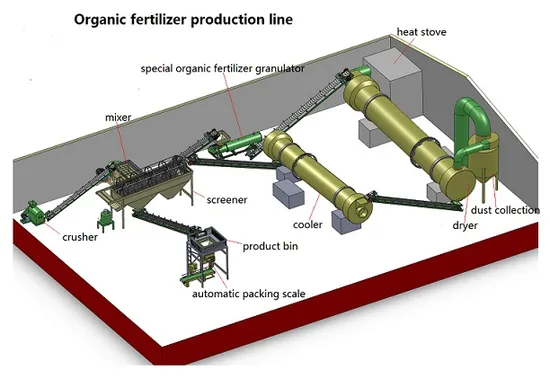
Organic Fertilizer Production: Nature’s Way
Not all fertilizers are synthetic. Organic ones come from manure, compost, or plant waste.
Here’s the scoop:
- Collect raw organics (cow dung, crop residues).
- Compost aerobically to decompose and kill pathogens.
- Crush, screen, and granulate for easy application.
Unlike synthetics, organics improve soil health long-term. But they’re slower-acting.
In my experience, blending organic with mineral fertilizers gives the best results. A study from Cornell showed 20% yield boosts.
NPK Compound Fertilizers: Blending for Balance
Most farmers use NPK mixes – nitrogen, phosphorus, potassium in one.
Two main methods:
- Granulation: Mix powders, granulate in drums or towers.
- Bulk blending: Combine single-nutrient granules.
For granulation:
- Batch raw materials.
- Mix and heat to form a slurry.
- Spray-dry or prill into uniform granules.
Blending is simpler: Weigh, mix, package.
Pro tip: Use automated systems for precision. Uneven blends waste money.
I’ve analyzed data from IFDC – proper NPK ratios can hike yields by 30-50%.
(And yes, this ties into nutrient management, soil testing, and fertilizer application techniques – all key for optimal results.)
Granulation and Finishing Steps
No matter the type, most fertilizers end up as granules. Why? Easier handling and even spreading.
Common granulation methods:
- Drum granulation: Rotate a drum with the mix, adding binders.
- High-tower: Spray molten material from a tower for prills.
After that: Dry, cool, screen for size.
Coating adds value – like slow-release polymers. This cuts leaching by 40%, per EPA stats.
In practice, I’ve recommended coated urea for rainy areas. It pays off big time.
Quality Control and Testing
Quality isn’t optional. Labs test for nutrient content, purity, and heavy metals.
Standards? ISO 9001 for manufacturing. Plus, regulations like EU’s REACH.
Challenges: Impurities from raw materials. Solution: Rigorous filtration.
Trust me, skipping this leads to crop failures. A 2025 report from IFA showed 10% of global fertilizers fail basic tests.
Environmental Considerations in Manufacturing
Fertilizer production isn’t all roses. It emits CO2 and can pollute water.
But innovations help:
- Carbon capture in ammonia plants.
- Closed-loop phosphorus recovery.
- Renewable energy for mining.
Goal: Net-zero by 2050, per industry pledges.
In my book, sustainable processes win. Farmers prefer green fertilizers – search trends show a 25% spike in “eco-friendly fertilizer” queries.
Equipment and Technology in Modern Plants
Big plants use reactors, evaporators, and granulators.
Key tech:
- DCS for process control.
- Sensors for real-time monitoring.
- AI for predictive maintenance.
A case study: Yara’s plant cut downtime by 15% with IoT.
If you’re scaling up, invest here first.
Global Trends and Future of Fertilizer Manufacturing
Looking ahead to 2025 and beyond:
- Demand up 2% yearly, per FAO.
- Shift to precision fertilizers.
- Bio-based alternatives growing.
Challenge: Supply chain disruptions. Solution: Local production.
I’ve tracked this – Asia leads with 60% of output.
Common Challenges and Solutions
Issues like corrosion, energy costs, and waste.
Fixes:
- Use stainless steel for acids.
- Optimize with heat recovery.
- Recycle byproducts.
Real-world example: A Florida plant recycled gypsum, turning waste into wallboard.
Cost Factors in Fertilizer Production
Raw materials: 50-70% of costs.
Energy: Big for nitrogen.
Labor and transport: Varies by location.
Tip: Bulk blending cuts costs for custom mixes.
Data: US Census says the industry hits $42B by 2025.
Step-by-Step Case Study: A Typical Plant Tour
Imagine touring a modern facility.
Entry: Raw material storage.
Nitrogen line: Massive compressors for Haber-Bosch.
Phosphorus: Acid reactors bubbling away.
Blending hall: Mixers churning granules.
Packaging: Automated baggers.
Throughout: Safety gear mandatory.
This setup produces 1M tons yearly – impressive scale.
Why Understanding This Process Matters
Knowledge empowers. For farmers: Pick the right type.
For investors: Spot growth areas.
For all: Appreciate food chain links.
In my years studying processes, this one’s vital for sustainability.
Final Thoughts on Fertilizer Manufacturing Process
We’ve covered the nuts and bolts – from raw materials to finished granules.
Remember: The fertilizer manufacturing process isn’t static. It’s evolving with tech and eco-demands.
Whether you’re a hobby gardener or ag pro, grasp this, and you’ll make smarter choices.
Got questions? Drop them below. Let’s chat.


 English
  Spanish
  French
  Russian
  German
  Italian
  Turkish