
Ever wondered how banana peels and cow manure transform into nutrient-rich plant food? Or why gardeners worldwide are ditching synthetic options? Let me explain…
The organic fertilizer manufacturing process turns waste into “black gold” for farmers. And with the global organic fertilizer market projected to hit $22.6 billion by 2027 (Grand View Research), understanding this eco-alchemy isn’t just fascinating—it’s essential for sustainable agriculture.
As a professional organic fertilizer production line manufacturer, I’ve spent years analyzing agricultural systems, and today I’ll break down every step for the organic fertilizer manufacturing process.
Ready to dig in? Sound good?

Why Organic Fertilizer? The Underground Revolution
Confession time: I used to think synthetic fertilizers were “good enough.” Then I saw the data. Studies show organically managed soils contain 28% more carbon (Rodale Institute), leading to:
- 40% higher crop yields during droughts
- 45% fewer greenhouse gas emissions
- Eliminated chemical runoff poisoning waterways
But here’s the thing: quality starts with the process. Screw this up, and you get foul sludge instead of fertile powerhouses. Let’s fix that…
Organic Fertilizer Manufacturing Process
Phase 1: Composting & Fermentation
Think of this as nature’s crockpot. Microorganisms break down raw waste into stable humus. Pro Tip: Skip this phase, and you’ll create toxic sludge instead of fertilizer.
Step 1: Raw Material Prep (The Foundation)
Garbage in, garbage out. Your recipe matters. I’ve seen setups fail by ignoring these ratios:
- Collection: Gather diverse wastes:
- Animal manure (cow, chicken, pig)
- Crop residues (rice hulls, corn stalks)
- Food scraps or brewery waste
(In Costa Rica, one facility processes 9 tons/day of restaurant waste!)
- Crushing: Grind chunks into 0.5-2 inch pieces. Larger? Microbes can’t penetrate. Smaller? It compacts. Wheel loaders or grinders save hours here.
- Moisture Adjustment: Aim for 50-60%.
- Too wet? Add sawdust/straw.
- Too dry? Mist with water.
(Test: Squeeze a handful—drops should barely form.)
- C:N Ratio Balancing: The secret sauce.
- Ideal: 25:1 to 30:1 carbon-to-nitrogen.
- High N (manure)? Add carbon-rich straw.
- High C (wood chips)? Add nitrogen-packed feathers.
Step 2: Aerobic Fermentation (Heat It Up!)
This is where things get steamy—literally.
- Piling: Stack in windrows (long rows) or fermentation tanks. Windrows should be 4-6 ft high/wide.
- Turning: Oxygen is life. Turn every 2-3 days with compost turners. In Australia, windrow turners process 1,000 m³/hour!
- Temperature Management:
- Days 1-3: 104°F (40°C) – mesophilic stage
- Days 4-7: 130-160°F (55-70°C) – thermophilic stage (kills pathogens)
- Hold >130°F for 72+ hours
- Maturation: Finished compost is dark brown, crumbly, and smells earthy (not rotten!). Takes 6-12 weeks.
Pro Tip: Use infrared thermometers to track heat zones. Cold spots? Turn immediately!
Phase 2: Deep Processing (Crafting Premium Products)
Ever notice how boutique fertilizers look uniform? That’s engineering.
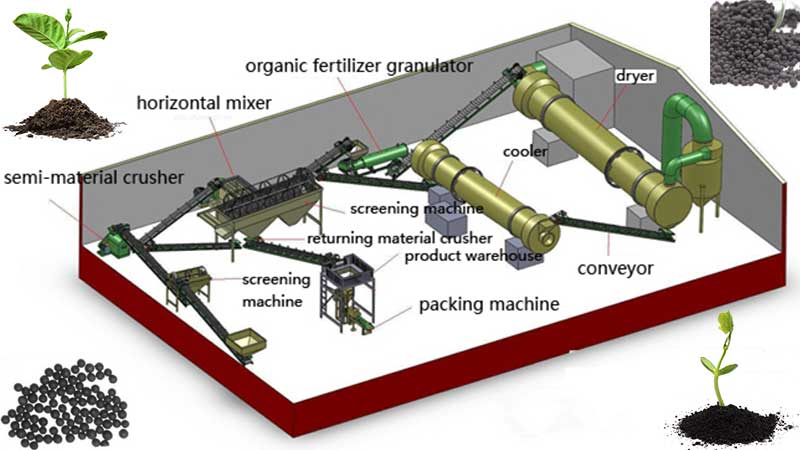
Step 3: Crushing & Screening
Mature compost is refined into powder:
- Crushing: Hammer mills pulverize clumps to <2mm
- Screening: Rotary screens filter debris like rocks or plastic. (Fines <10mm proceed; oversize gets recycled.)
Step 4: Nutrient Enhancement (Optional)
Boost value with additives:
- Microbial inoculants (Bacillus subtilis)
- Rock phosphate for phosphorus
- Humic acid for soil structure
- Binding agents if pelletizing
Step 5: Granulation (Pellet Perfection)
Because powders blow away in wind. Granulation solves this.
- Equipment Choices:
- Disc granulators (best for small batches)
- Rotary drum granulators (handles 15-30 tons/hour)
- New-Type Organic Granulator (global favorite)
- Process: Material tumbles while liquid binders (water/starch) are sprayed. Forms 2-6mm pellets.
| Granulator Type | Capacity (tons/hr) | Power (kw) | Best For |
|---|---|---|---|
| Disc | 1-5 | 15-30 | Small farms |
| Rotary Drum | 8-30 | 45-110 | Large facilities |
| New-Type | 3-8 | 37-75 | Versatile output |
Step 6: Drying & Cooling
Wet pellets = mold. Fix it fast:
- Rotary dryers reduce moisture to 10-15% at 400°F (204°C)
- Rotary coolers drop temps to ambient levels
- Saves 80% of storage spoilage losses
Step 7: Coating & Packaging
The final polish:
- Coating: Apply microbial layers or slow-release resins
- Packaging: Automated baggers fill 5-50kg sacks. (Double-bucket baggers pack 20 tons/hour!)
Your 2025 Manufacturing Blueprint: Cost vs. Scale
Thinking of starting a facility? Let’s get practical.
Small-Scale (1-5 tons/day)
- Setup Cost: $60,000-$90,000
- Equipment: Windrow turner, crusher, mixer
- Space: 1,000-2,000 sq ft
- ROI: 18-24 months (local farm demand)
Commercial-Scale (10-20 tons/hour)
- Setup Cost: $360,000-$550,000
- Equipment: Wheel-type turner, drum granulator, dryer/cooler system
- Space: 11,000+ sq ft
- ROI: 12-18 months (export markets)
Case Study: A Kenyan plant processes 100,000 MT/year of palm waste into pellets. Their secret? Locating the facility inside the plantation—cutting transport costs by 70%.
3 Critical Trends Shaping 2025
- Automation Explosion: PLC-controlled systems now run entire plants with 1-2 operators. Sensors track temperature/moisture 24/7.
- Biogas Integration: 85% of new EU plants merge with digesters—converting slurry into fertilizer + energy.
- Nano-Coatings: Time-release shells boost nutrient efficiency by 200% (Journal of Agricultural Science).
Mistakes That Ruin Fertilizer (And How to Avoid Them)
In my audits, I see three recurring errors:
- Skipping Thermophilic Phase
- Result: E. coli outbreaks.
- Fix: Log temperatures hourly.
- Ignoring C:N Ratios
- Result: Ammonia stench or sludge.
- Fix: Test materials with a $20 soil kit.
- Over-Drying Granules
- Result: Dusty pellets that crumble.
- Fix: Maintain 12-14% moisture post-drying.
The Future Is Circular
Imagine cities where food waste becomes farm nutrients—closing the loop. In 2025, that’s reality. California now mandates 75% organic waste recycling, birthing 200+ micro-plants.
But here’s the bottom line: Whether you’re a homesteader or CEO, the organic fertilizer manufacturing process transforms waste into wealth. Master these steps, and you’re not just making fertilizer—you’re rebuilding soil, sequestering carbon, and feeding the future.
Ready to start your own operation? Share your biggest question below! 👇


 English
  Spanish
  French
  Russian
  German
  Italian
  Turkish